
Walk
Best suited to nearby, clustered stops when the pedestrian route is continuous and the time, weather and physical effort are manageable.
During a short stay in Ottawa, choose transport journey by journey: walk for nearby, well-connected stops, use OC Transpo for longer connections when access, waiting and transfer time remain worthwhile, and drive when dispersed destinations or personal constraints outweigh parking and traffic overhead. Compare the whole door-to-door journey and recheck time-sensitive fares, schedules and service status before departure.
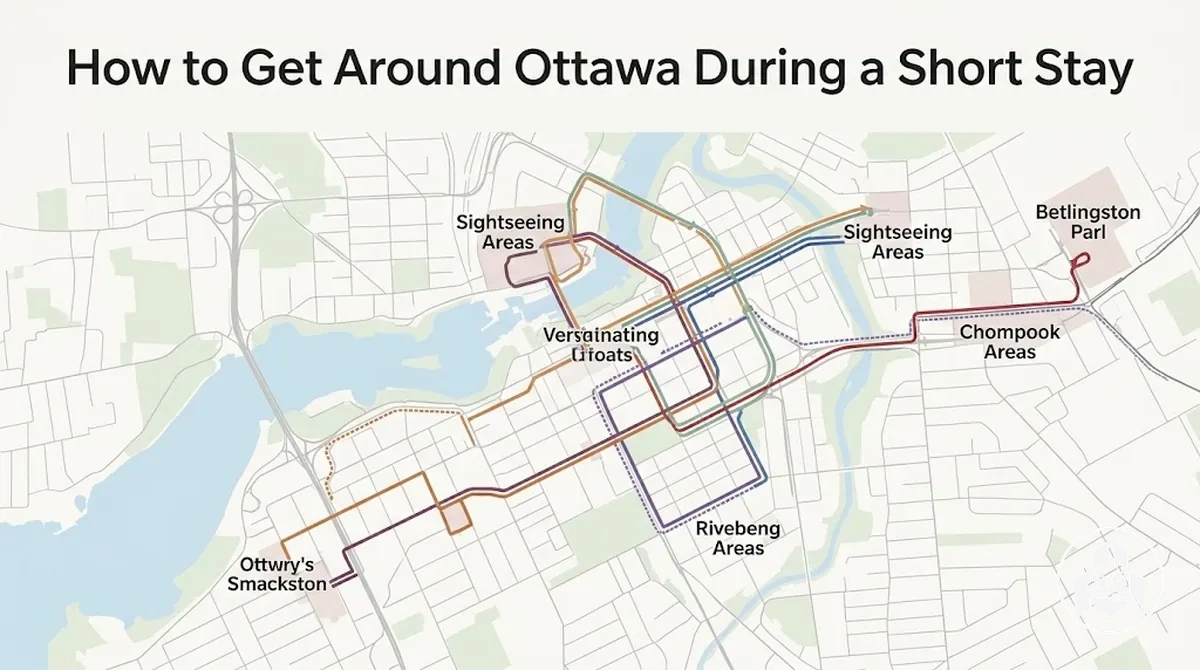
Choose the mode that removes the most journey friction
Judge each sightseeing leg from origin to destination, not by the transport mode alone. Include access walking, waiting, transfers, parking, weather exposure and personal constraints.
Walk
Best suited to nearby, clustered stops when the pedestrian route is continuous and the time, weather and physical effort are manageable.
Public transit
Useful when it replaces a substantial walking segment and stop or station access, waiting and transfers do not erase the benefit.
Drive
Can simplify dispersed or poorly connected journeys, especially with luggage, mobility or schedule constraints, if parking and traffic do not add more burden.
A short stay can therefore use more than one mode in the same day: the efficient choice is the one that fits the specific journey with the least avoidable time, effort and uncertainty.
Walking and public transit should be compared for the same Ottawa journey using shared criteria rather than by assuming one mode is preferable overall.
Distance, door-to-door time, waiting, transfers, weather exposure and proximity to sightseeing stops shape the practical choice, while the image below shows the two modes as alternative ways to cover the same sightseeing connection.

For route efficiency, group attractions before choosing transport so that nearby sightseeing stops are considered together before comparing walking with public transit.
The comparison should then use the complete door-to-door journey, including access walking, waiting and transfers where they apply, rather than only distance or time spent on a vehicle.
The criteria below organise those shared conditions without treating either mode as universally preferable.
| Criterion | Walking | Public transit | Practical implication |
|---|---|---|---|
| Distance | More practical when sightseeing stops are close enough for a comfortable continuous walk. | May become more practical when the connection is too long or inconvenient to cover on foot. | Compare the distance with the effort and time required to reach the destination. |
| Door-to-door time | Travel time is mainly the time spent walking directly between the two points. | Total time can include access walking, waiting, the transit ride, transfers and the final walk. | Compare the complete journey rather than only time spent on the vehicle. |
| Waiting and transfers | No scheduled waiting or transfer is required for a direct walking journey. | Waiting or a transfer can add overhead before reaching the destination. | A short journey may favour walking when transit overhead is large relative to the connection itself. |
| Weather exposure | The traveller remains outdoors for most or all of the journey. | Transit can reduce the portion of a longer journey spent walking outdoors, although access walking may remain. | Weather can change the practical balance even when the origin and destination stay the same. |
| Proximity to stops | Nearby sightseeing stops can be connected directly on foot. | A nearby stop or station reduces access walking, while a more distant one increases it. | Consider both attraction proximity and transit access before selecting the mode. |
For example, a traveller moving between two closely grouped sightseeing stops may choose walking because it avoids waiting and transfer overhead.
The same traveller may use public transit for a longer connection where walking distance or weather exposure makes that segment less practical, so different parts of one short stay can justify different modes.
Walking is practical between nearby Ottawa sightseeing stops when proximity, route continuity and available sightseeing time make the segment comfortable to cover on foot.
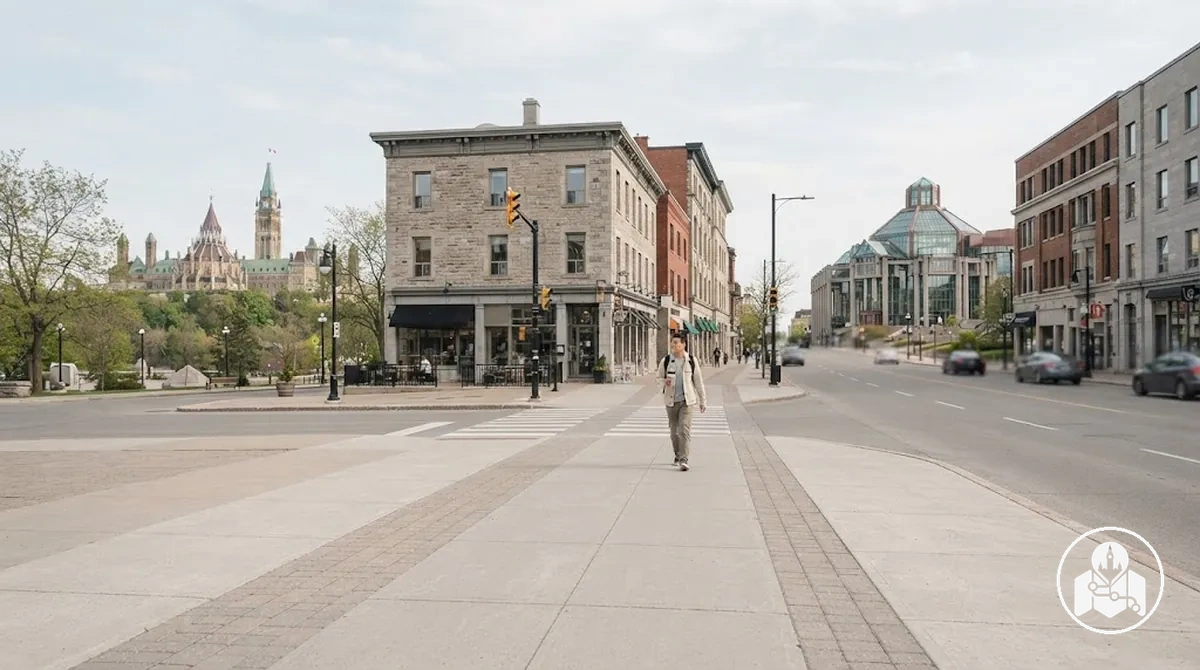
What changes the walking decision
Decision rule: keep the segment on foot while time, route conditions and effort remain manageable; switch modes when those costs outweigh the convenience of walking directly.
For example, closely grouped stops in a central area can make walking useful because the traveller can continue directly from one destination to the next without separate transport.
Travellers who want to turn several suitable segments into a complete route can plan a walking itinerary separately.
Public transit becomes more useful for a longer or less convenient Ottawa connection when the walking effort avoided outweighs the access, waiting and transfer burden.

Time and effort begin before boarding: include the walk from the origin to the stop or station.
Waiting is part of door-to-door travel time, so it matters most on short or time-sensitive connections.
Count in-vehicle time plus any transfer walk or additional waiting period.
The last leg from the stop or station to the destination can change how convenient the whole trip feels.
A longer connection may therefore justify transit when it reduces overall walking effort without adding enough access, waiting or transfer burden to offset that advantage.
For example, a longer direct connection with convenient access at both ends may make public transit practical because the ride replaces a substantial walking segment.
For a short connection, however, reaching a stop, waiting or transferring can create enough overhead that walking remains the more practical option.
OC Transpo provides bus and O-Train public-transit service in Ottawa, and visitors can use either network component alone or combine them within one sightseeing journey.
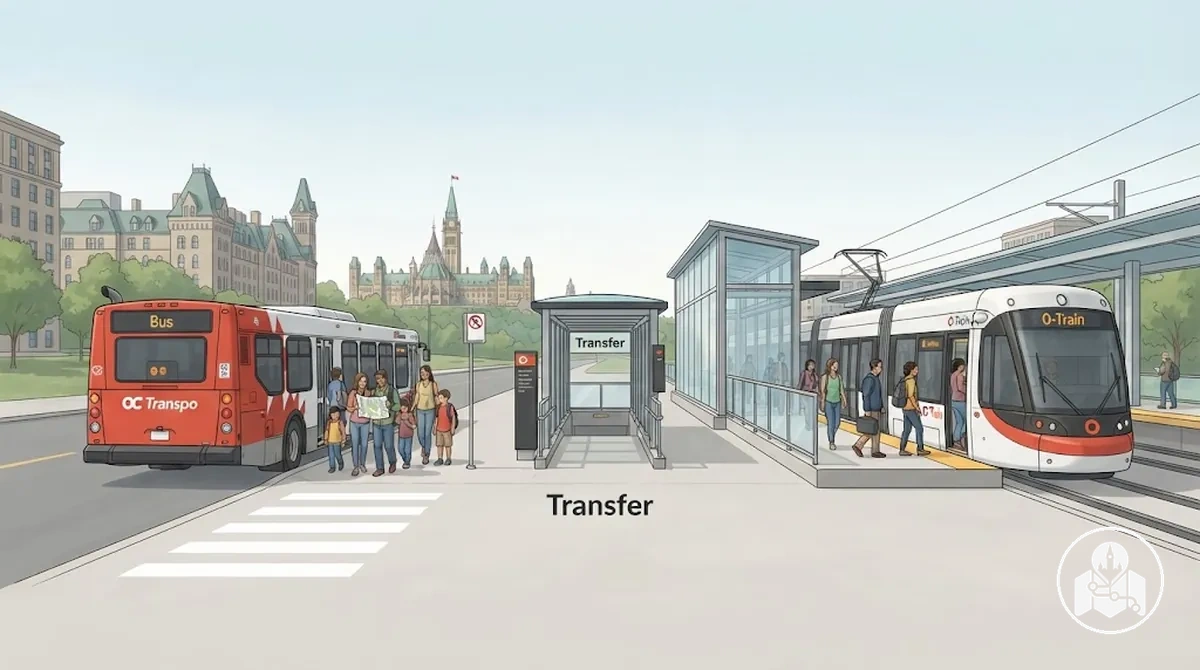
How the visitor network fits together
An OC Transpo visitor needs to match the fare product, payment method and transfer entitlement to the planned journey.
The fare values shown here list an adult single ride at $4.10 with Presto or O-Payment and $4.15 with cash, with transfers valid for at least 90 minutes from the first tap or single-ride purchase and longer during specified periods. Because fares and transfer rules are time-sensitive, verify the exact amount and validity window before travel.
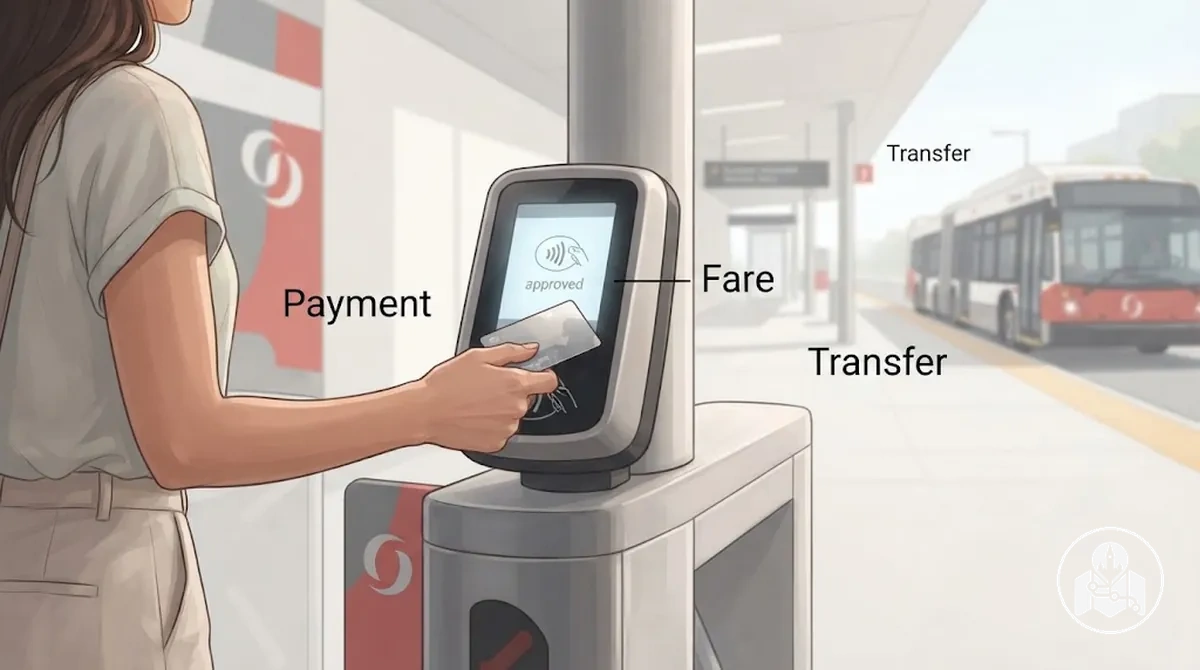
A payment method is how the fare is paid, while the fare product determines what travel is purchased and the transfer entitlement determines whether another boarding is covered.
OC Transpo accepts Presto for pay-per-ride travel, while O-Payment accepts Interac debit, Visa, Mastercard and supported mobile wallets for the regular adult fare.
Cash can be used on buses with exact change, and single-ride fares can be purchased at ticket machines using cash, debit or credit.
For O-Payment transfers, OC Transpo instructs visitors to keep using the same physical card or the same mobile-wallet payment method so the system can recognise the valid transfer.
| Payment or fare option | Where/when used | Transfer implication | Visitor note |
|---|---|---|---|
| Presto pay per ride | Tap a loaded Presto card on a bus reader or at an O-Train fare gate; the adult single-ride fare shown here is $4.10. | The transfer period begins when the card is tapped and permits additional eligible boardings during the valid transfer window. | OC Transpo requires Presto for discounted fare categories. |
| O-Payment | Tap an accepted debit card, credit card or supported mobile wallet on the fare reader; the regular adult fare shown here is $4.10. | Use the same card or mobile-wallet payment method during the valid transfer window to avoid another adult fare. | OC Transpo lists an O-Payment adult daily fare cap of $12.25. |
| Cash or single-ride fare | Pay the $4.15 cash fare shown here with exact change on a bus, or buy a single ride from a ticket machine using cash, debit or credit. | A valid paper or single-ride transfer can be used for further eligible boarding until its transfer period expires. | Cash pays the regular adult fare rather than a discounted fare. |
| DayPass | OC Transpo lists a one-day DayPass at $12.25 for repeated travel during its validity period. | Travel covered by the pass does not depend on a single pay-per-ride transfer window. | OC Transpo states that a one-day DayPass remains valid until 3:00 a.m. the following morning. |
For a visitor making several journeys in one day, the $12.25 DayPass or the equivalent O-Payment daily fare cap shown here can cover repeated adult travel without continuing to accumulate single-ride charges beyond that amount.
Concession fares have separate eligibility and payment requirements, so visitors using one should confirm the current rule with OC Transpo before travel because fares, transfer periods and eligibility conditions can change.
Plan an OC Transpo journey by choosing a route from the intended origin to the destination, then confirm the current service status before departure.
A usable plan combines route selection with checks for access walking, transfers, expected travel time and any disruption that could affect the journey.
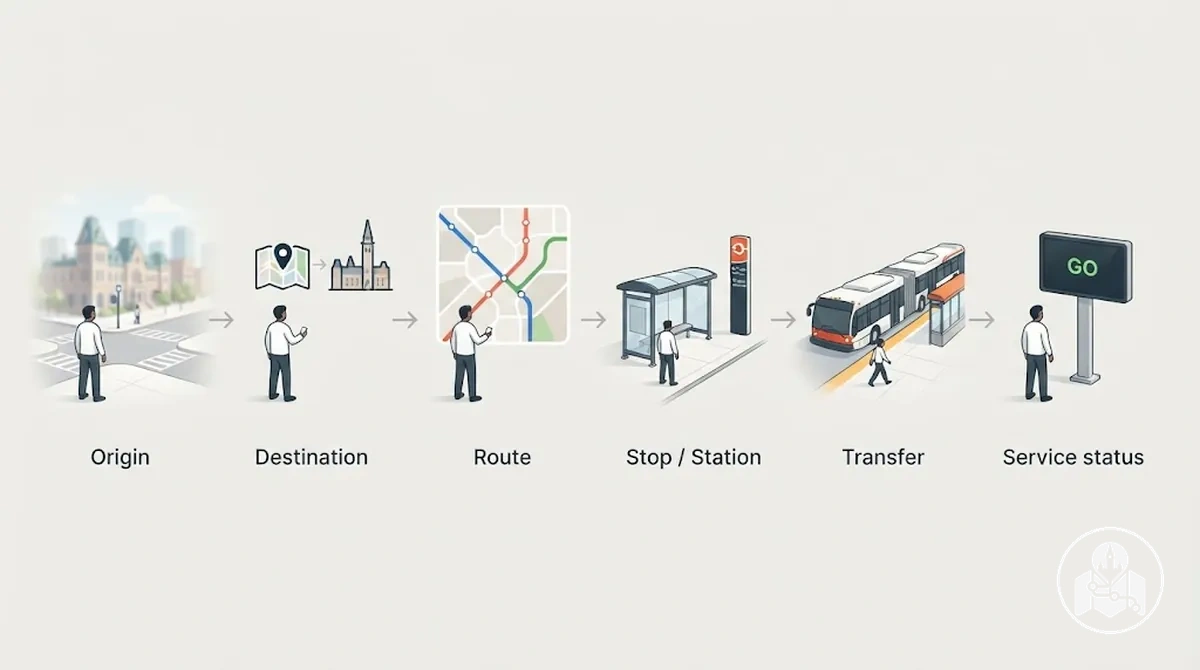
Route selection and service verification are separate but connected tasks, so work through the journey in sequence before relying on the planned connection.
Route patterns, expected timing and service availability can change, so current operational information should take precedence over assumptions based on a static map or an earlier plan.
Accommodation location can also change access walking and route convenience, which is one transport reason to choose where to stay for easier sightseeing.
Recheck current service close to departure when the journey is time-sensitive.
A car is not universally required for a short stay in Ottawa; whether it improves the trip depends on the geography of the itinerary, accommodation location and traveller constraints.
When the main sightseeing stops are clustered and have practical transit access, walking and public transit may be sufficient; more dispersed destinations or tighter mobility and schedule requirements can make driving more useful.
Walking + transit usually fit when
Driving may simplify the plan when
When the itinerary and traveller constraints make car-free travel plausible, the next step is to visit Ottawa without a car using a plan built around suitable walking and transit connections.
Central sightseeing can work without driving when accommodation is close to clustered attractions, practical walking links connect nearby stops and transit covers the longer gaps.
These conditions reduce first-mile and last-mile transport needs. If the stay is far from the central visitor area or planned destinations have weak connections, that car-free advantage becomes less certain and should not be generalised to the rest of Ottawa.
For example, a visitor staying near a central cluster may walk between several attractions and use transit for an occasional longer connection, without needing a car for that part of the stay.
Driving may simplify an Ottawa short stay when dispersed destinations, weak direct transit connections, limited time or personal constraints make walking and public transit inefficient for the planned journeys.
Its advantage is strongest when it removes several awkward connections or transfers, especially with luggage or mobility needs. Parking, traffic, route complexity and vehicle retrieval are part of the same door-to-door calculation and can offset the benefit.
For example, driving may help a traveller cover several dispersed stops within a limited schedule, but it may add little when parking and traffic create more delay than the car removes.
Waiting, a tight transfer and an unexpected service disruption can consume a disproportionate share of a short stay when they extend total journey time or break a planned connection.
Build a buffer around the parts of the journey most exposed to access time, waiting, transfers and current-service changes rather than assuming the scheduled trip will unfold without interruption.
Use the following verification points after selecting the route to identify where schedule pressure could develop and what adjustment may keep a time-sensitive journey workable.
Disruption risk and waiting conditions can change, so current information should shape the size and location of a buffer without being treated as a guarantee of the eventual travel time.
If the primary option becomes impractical, use the prepared fallback or adjust the schedule rather than assuming every delay can be predicted; broader planning guidance can help travellers avoid transport and timing mistakes.