
Ottawa Travel Itineraries for One, Two and Three Days
For a first Ottawa short stay, use one day for a focused cluster of priority sights, two days to add depth, a second practical area, or a slower pace, and three days to add broader coverage plus more buffer. Plan by usable sightseeing time rather than calendar days alone: group nearby stops, include visits and transfers in the same time budget, and adjust for opening constraints and actual weather conditions.
Choose the shape of your Ottawa short stay
Stay length changes the amount of breadth, depth, pace and buffer you can realistically carry. Choose the day count first, then test the route against the same feasibility rules.
Plan every stay in this order
- Choose priority sights.
- Group compatible nearby stops.
- Count visit time, transfers and opening constraints.
- Keep enough buffer to adjust the route.
Table of Contents
How Ottawa Itineraries Change from One to Three Days
Moving from one day to two days to three days increases available itinerary capacity. That extra capacity can increase sightseeing breadth, support longer visits, reduce pace pressure, or create more buffer rather than simply adding more stops.
How the extra time should be used depends on priority, attraction duration, route demands, opening constraints and transfer overhead. A useful comparison therefore applies the same planning attributes to each stay length.
Travellers still deciding between these trade-offs can choose how many days to spend in Ottawa by matching trip length to their priorities and preferred pace.
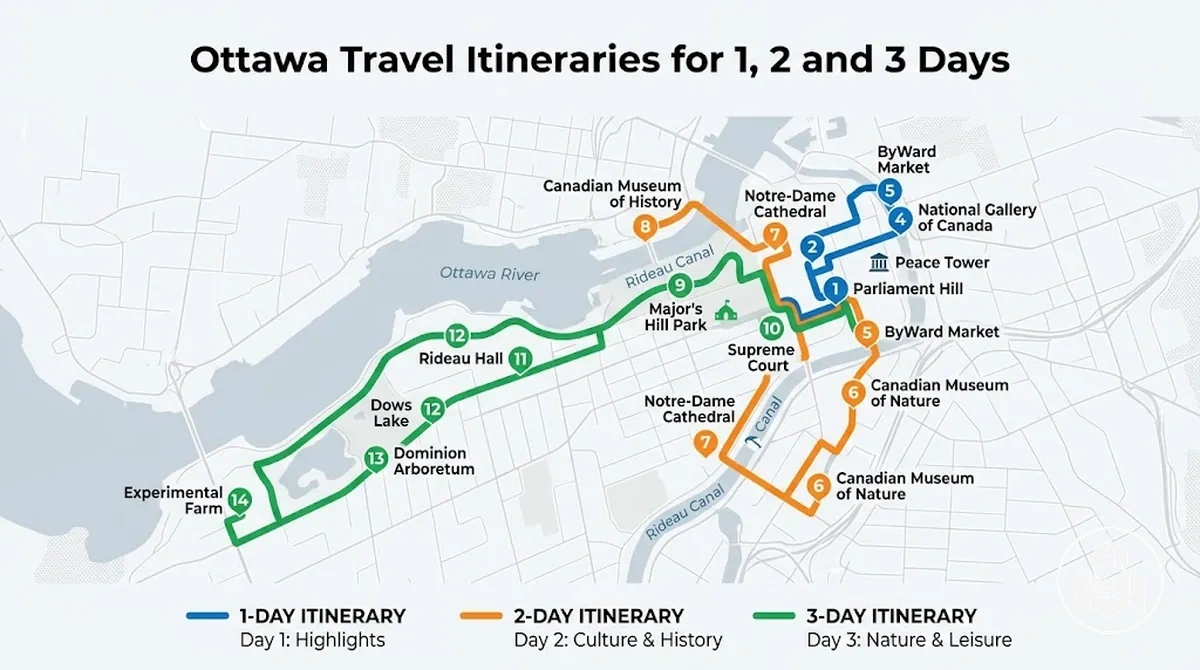
The image below shows how spatial scope can broaden across one-, two- and three-day stays, while the table compares the planning attributes directly.

| Stay length | Sightseeing breadth | Pace | Travel overhead | Buffer / flexibility |
|---|---|---|---|---|
| One day | Focused coverage of a limited sightseeing area or closely grouped priorities | More concentrated, especially when visits take longer | Most practical when transfers between priority sights are kept limited | Less buffer for longer visits, delays, or changing conditions |
| Two days | Added depth or scope for another practical attraction cluster | Can be less compressed when priorities remain geographically coherent | More practical to absorb when each day groups nearby attractions | More flexibility for longer visits or adjustments |
| Three days | Broader coverage with greater scope for additional attraction clusters | Can support a slower pace when the extra time is not used only for more stops | Can accommodate more transfers, while efficient grouping preserves more sightseeing time | Greater buffer for longer museum visits, weather changes, delays, or revised priorities |
Planning condition: compare stays by usable sightseeing hours. A late arrival, early departure, or fixed booking can make a nominal “day” materially shorter than a full sightseeing day.
The main trade-off is concentration versus flexibility: a shorter stay places more weight on a focused route, while a longer stay gives more room to adjust breadth, depth, pace and buffer.
One Day: Keep the Itinerary Focused
A one-day Ottawa itinerary requires a tightly filtered set of high-priority sights because available hours are limited. Unnecessary movement therefore competes directly with sightseeing time.
A stop is practical when it is important to the visitor, close to other selected attractions, compatible with the available hours, and workable within its expected visit duration and opening window.
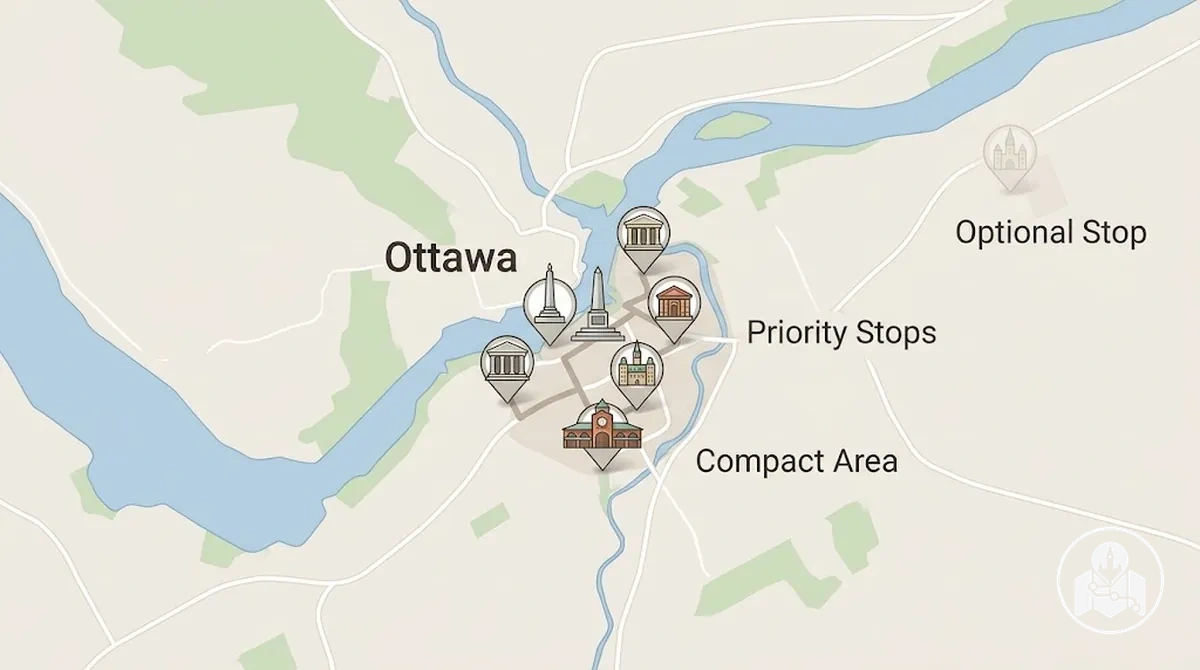
For many first-time visitors, a compact central plan can combine the Parliament Hill, Rideau Canal and ByWard Market area, while a museum or another interest-led stop can replace or extend part of that cluster when timing and priorities support it. These are examples of a coherent central focus, not a fixed ranking.
A lower-priority or geographically isolated stop should become optional when reaching or visiting it would displace more important sights or leave too little buffer for the rest of the day.
For a detailed one day in Ottawa plan, these constraints can be applied to a specific route.
Two Days: Expand the Sightseeing Plan
A two-day Ottawa itinerary allows room for added depth, a second practical attraction cluster, or a slower pace.
How the second day is used depends on interests and geographic fit: longer visits support depth, another practical sightseeing area increases breadth, and fewer planned stops can create a less compressed itinerary.
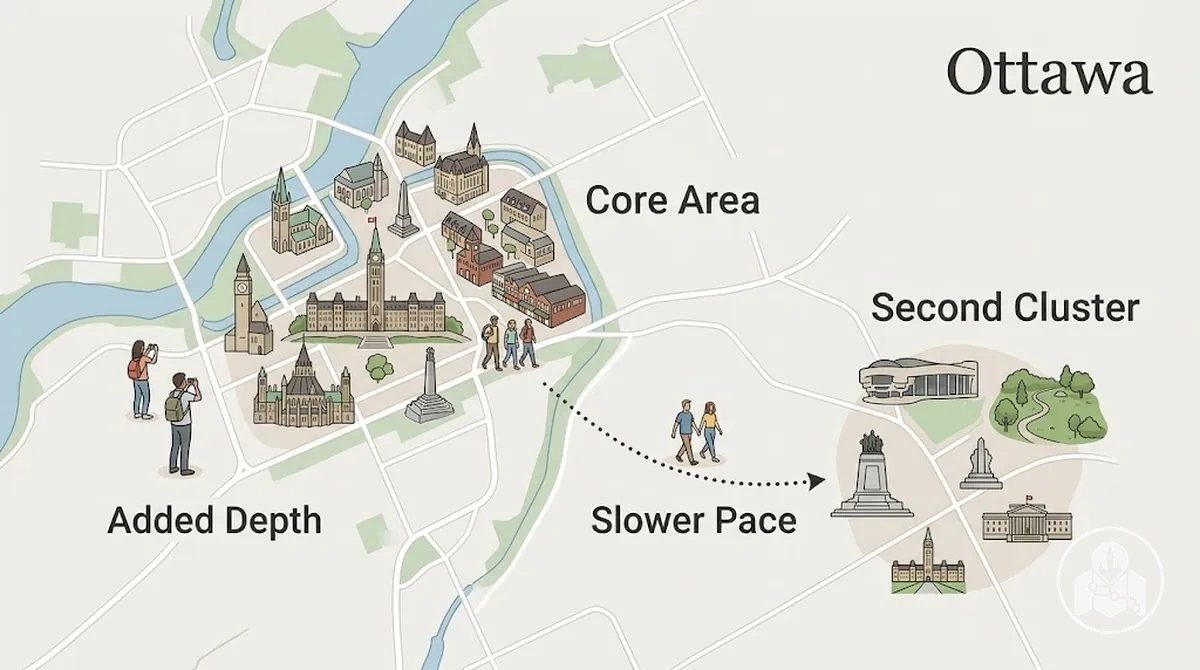
Visit duration and travel overhead determine which use of the added time is practical. Attractions that fit geographically with the existing plan can broaden coverage without making transfers the main activity, while time-intensive priorities may justify devoting more of the second day to depth.
A detailed two days in Ottawa plan can apply these choices to a specific route.
The second day should therefore be allocated to the benefit that best matches the visitor’s goals rather than treated as an automatic instruction to double the number of stops.
Three Days: Add More Flexibility to the Itinerary
A three-day Ottawa itinerary creates room for broader coverage, but its most useful additional attribute is greater flexibility and buffer time.
The added capacity can support deeper visits, an additional area, or a less compressed pace, depending on interests, transfer burden and conditions.
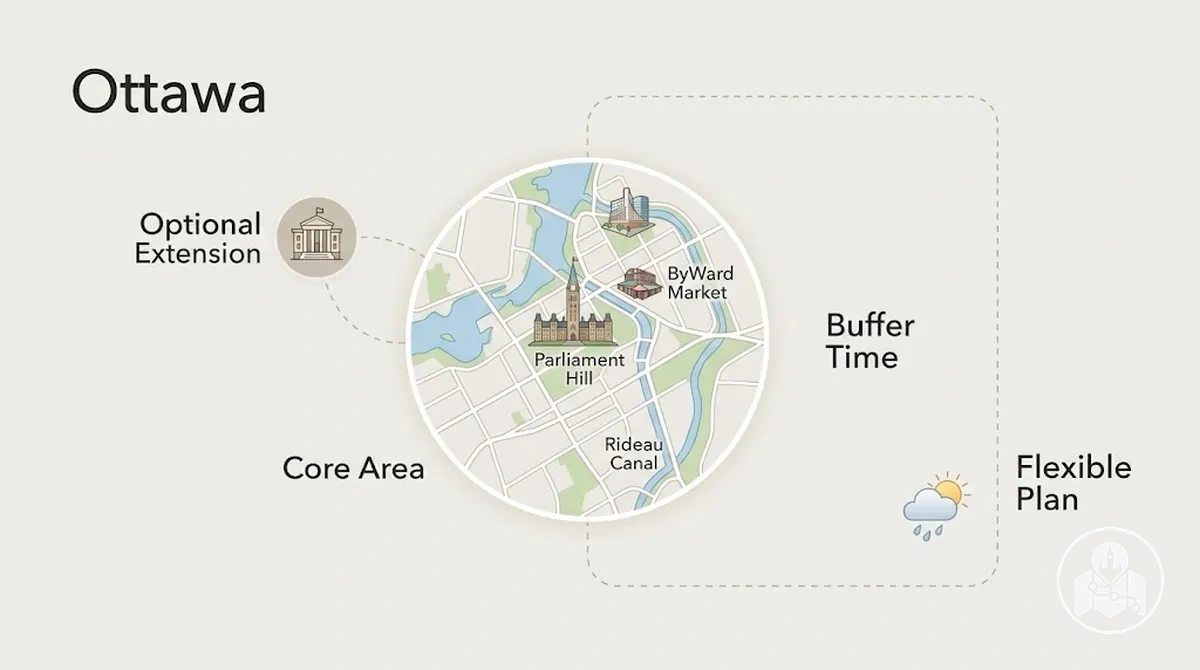
The third day may be used to spend longer at selected sights, expand into another sightseeing area when the geographic fit is practical, or leave more spare time for breaks and contingencies.
Buffer time also makes weather-related or timing-related rearrangement easier because a change to one part of the plan is less likely to compress every later stop.
A detailed three days in Ottawa plan can apply that flexibility to a specific route.
The third day should improve the itinerary’s fit and resilience rather than simply maximise the number of stops.
How to Prioritise Ottawa Sights on a First Visit
For a first visit, prioritise Ottawa sights by how well they represent the goals of the trip before filling remaining time with secondary options.
The main criteria are significance, distinctiveness, geographic fit, time cost, opening constraints and personal interest. Together they determine whether a sight deserves limited sightseeing time under the conditions of the itinerary.
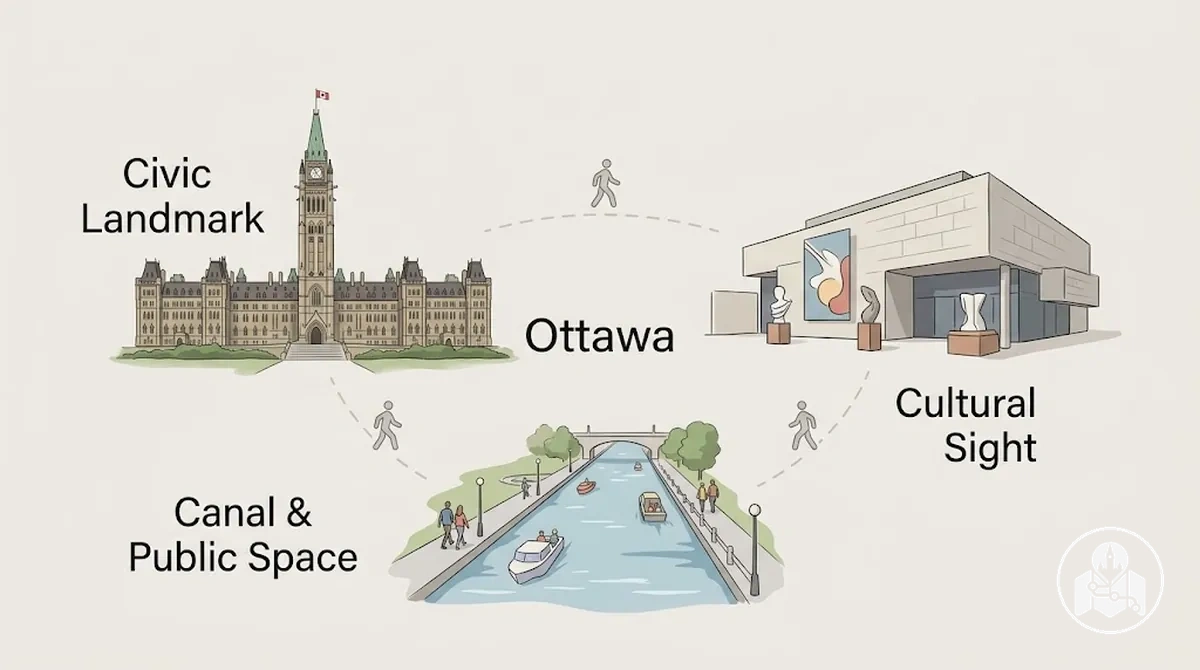
Use these criteria as a filter rather than a universal attraction ranking:
- Significance: give a sight more priority when its civic, historical, cultural, or other relevance closely matches the purpose of the first visit.
- Distinctiveness: favour an attraction when it offers an experience or setting that is particularly characteristic of Ottawa and relevant to the visitor’s goals.
- Geographic fit: a sight that fits near other selected attractions can reduce unnecessary movement, while a geographically isolated stop may become optional when it adds substantial transfer burden.
- Time cost: a time-intensive sight can take priority over several minor stops when its significance or personal relevance justifies a larger share of the available time.
- Opening constraints: an attraction becomes less feasible when its available visiting window does not fit the itinerary, so timing can change its practical priority.
- Personal interest: museums, public spaces, markets, or civic landmarks can move higher or lower in the plan according to what the visitor actually wants from the trip.
For example, Parliament Hill can represent a civic focus, the Rideau Canal can represent canal and public-space sightseeing, and a museum can provide a cultural focus. These examples serve different first-visit interests rather than forming a fixed ranking.
Priority is therefore conditional on the visitor’s goals and constraints, not universal across all first visits.
Plan the Route Around Nearby Attractions and Travel Time
An Ottawa sightseeing route should start with priority sights, then use geographic grouping to reduce avoidable backtracking while protecting time for the attractions that matter most.
Route feasibility depends on each attraction’s location and visit duration, the movement mode used between stops, the resulting transfer time, and any opening constraints.
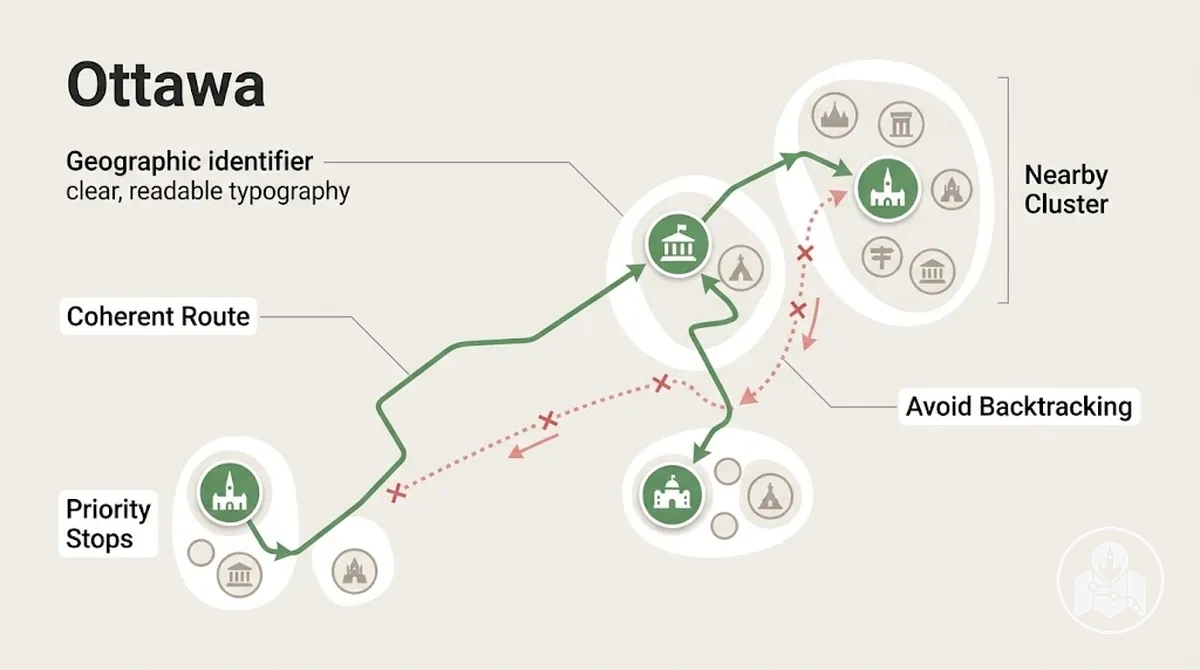
- Identify priority sights: establish which attractions should receive itinerary time before arranging secondary stops around them.
- Group nearby attractions: place priority sights and compatible nearby attractions into geographic clusters so the route avoids unnecessary backtracking.
- Estimate transfer demands: consider the intended movement mode and verify transfer time when precise timing matters; otherwise, use a qualitative allowance rather than an unsupported exact duration.
- Account for timing constraints: compare expected visit duration and opening constraints with the order of stops so that an attraction is not included where its timing makes the sequence impractical.
- Check feasibility: confirm that visits and transfers fit within the available sightseeing time; if they do not, reduce or reorder stops rather than compressing the route beyond a realistic fit.
An inefficient route moves back and forth between separated attractions, increasing transfer burden and leaving less time for sightseeing, while a geographically coherent route progresses through compatible clusters with fewer avoidable reversals.
The final feasibility check should expose this kind of route problem before the itinerary is fixed, while travellers can separately avoid common Ottawa itinerary mistakes that extend beyond route construction.
Group Nearby Ottawa Attractions Before Setting the Route
Nearby Ottawa attractions belong in the same practical cluster when geographic proximity also aligns with compatible opening windows, visit duration and access conditions.
Closeness alone is not sufficient: two sights can be near each other and still form a poor sequence when timing, visit length, or access conditions conflict.
- Location
- Stops are close enough that grouping them reduces unnecessary movement or backtracking.
- Timing
- Their opening windows can fit the same practical route sequence.
- Visit duration
- Time spent at one stop does not crowd out a higher-priority stop in the same cluster.
- Access conditions
- The intended movement mode and access needs make the sequence workable in practice.
When these conditions align, grouping preserves more usable sightseeing time; when they conflict, nearby sights may be better treated as separate choices despite their proximity.
Travellers who need broader geographic context can group Ottawa attractions by area before deciding which nearby sights belong together.
Allow for Travel Time Between Sightseeing Areas
Transfer time between Ottawa sightseeing areas uses the same limited itinerary time budget as attraction visits and buffer time, so it directly reduces how much of the day remains for sightseeing.
The size of that effect varies with movement mode, distance, waiting, accessibility and schedule sensitivity; precise transfer timing should therefore be checked for the intended day and mode when it materially affects the route.
If the planned parts exceed the hours actually available, simplify, reorder, or remove a stop rather than assuming the transfer burden can be ignored.
A route with more nominal stops can therefore provide less useful attraction time when repeated transfers consume too much of the day.
Travellers comparing practical movement options can separately review how to get around Ottawa during a short stay without turning the itinerary itself into a full transport-mode comparison.
Adjust the Route for Season and Weather Conditions
Season and day-to-day weather can change an Ottawa itinerary’s route order, pace, buffer time, and the suitability of indoor and outdoor stops.
The degree of adjustment depends on the actual conditions, so a sound route may need only a small sequencing change rather than a completely different itinerary.
- Cold, rain or heat
- Can make a slower pace and additional buffer more useful when movement or comfort is affected.
- Daylight
- May influence when outdoor stops fit most naturally in the route.
- Crowding or waiting
- Can increase the value of spare time when access or movement takes longer than expected.
- Indoor options
- Can provide route flexibility when outdoor conditions are less suitable without requiring the whole plan to be replaced.
The practical aim is to adjust sequencing and buffer according to the conditions encountered rather than assume that one seasonal pattern determines every visit.
Timing therefore influences route design and comfort without establishing a universally preferable season for every traveller.
Visitors who need a broader seasonal comparison can separately choose the best time for an Ottawa trip, while this itinerary step remains focused on adapting an existing route to actual conditions.