
Common Ottawa Itinerary Planning Mistakes
Common Ottawa itinerary planning mistakes include overpacking the day, ignoring opening or timed-entry constraints, underestimating door-to-door travel time, leaving too little buffer for ordinary delays, and building a weather-sensitive day with no workable fallback. A day is realistic when visits, transfers, meals and recovery margin fit inside the usable sightseeing window while fixed-time access conditions are respected.

Ottawa itinerary feasibility check
Use this check before finalising a sightseeing day. Every required activity must fit the same usable time window, and fixed commitments must still be reachable with enough margin for ordinary variation.
Workable day: visits + door-to-door transfers + meals + recovery buffer fit within usable sightseeing time, with opening and timed-entry constraints respected.
- Anchor fixed constraints.Place timed entry, reservations, event starts, opening windows and closing cutoffs before movable activities.
- Test the visit load.Use realistic visit duration plus meal time rather than judging the day by attraction count alone.
- Count the full transfer.Include access walking, waiting or parking, the main trip, the final walk and arrival margin between stops.
- Protect recovery margin.Leave enough slack for queues, slower meals, navigation and other small delays before later fixed commitments.
- Keep weather-sensitive blocks flexible.Use movable timing or a practical indoor alternative when an activity depends on conditions that can change.
If the plan fails a check: move, remove or reorder commitments before trying to shorten every visit, then recheck the whole day.
Attraction hours, reservation rules and weather-sensitive access can change by date, so verify current details before treating a stop as fixed.
An Ottawa itinerary has finite usable time. Attraction visits, door-to-door travel, meals and buffer consume that time, while opening hours and timed entry can constrain when stops occur. Weather disruption can also require the day to change.
Ambition alone does not determine whether the plan works; planned commitments must fit the day's access requirements, movement demands and available recovery margin.
Table of Contents
How to Tell When an Ottawa Itinerary Is Unrealistic
An Ottawa itinerary is unrealistic when its fixed commitments, realistic visit durations, transfers, and recovery time cannot fit inside the usable sightseeing window.
The schedule must account for opening hours, queues, travel time, meals, and buffer time rather than attraction count alone.
The image below shows how individually reasonable commitments can accumulate until they exceed the time available.

Repeated lateness, rushed visits, missed time windows, or no recovery margin can signal different constraints rather than one universal planning error.
A realistic diagnosis separates excessive activity from fixed-time conflicts, inefficient movement, and insufficient buffer time.
The table distinguishes these signals from the constraint that should be checked next.
| Signal | What It Suggests | Check | Planning Implication |
|---|---|---|---|
| Visits repeatedly feel rushed | The planned activity may require more time than the usable sightseeing window provides | Compare realistic visit duration, meals, queues, and fixed commitments with the time available | Reduce or shorten commitments until their combined time demand fits the day |
| A timed stop is repeatedly at risk | Fixed-time commitments may conflict with opening hours, reservations, or earlier activities | Check closing times, timed entry, expected visit duration, and arrival margin | Adjust flexible activities around the fixed-time commitment |
| Large parts of the day are spent moving | Travel inefficiency may be consuming time intended for sightseeing | Check door-to-door travel time, route sequence, distance, and transport changes | Reduce unnecessary movement or change the order of stops |
| Any delay disrupts the remaining schedule | The Ottawa itinerary may have insufficient buffer time | Check the unscheduled margin available for queues, meals, weather disruption, and slower movement | Create more recovery margin before adding further commitments |
Total stay length is another constraint, but it does not diagnose the problem by itself.
Too little overall trip time can force more activity into each sightseeing day, so it may be necessary to choose a realistic trip length.
The daily plan still needs to be checked against visit duration, access windows, movement, and buffer time.
For example, several stops can each appear reasonable on their own while their visit periods, transfers, meal break, and one fixed reservation together occupy the entire usable day.
Even without an excessive attraction count, those combined commitments can leave no margin for a queue, slower transfer, or weather disruption.
Diagnose the limiting constraint before changing the Ottawa itinerary.
Overpacking a Day With Too Many Attractions
An overpacked Ottawa itinerary places too many attractions into a day to complete them at a realistic pace.
The cumulative load can lead to rushed sightseeing, shortened visits, skipped activities, or repeated lateness when the planned commitments exceed the time available.
Stop count alone does not determine whether a day is overloaded.
Visit duration, travel time, fixed reservations, meal breaks, and traveller pace all consume or constrain the available schedule, so the same number of stops can create very different demands.
The image below shows how attraction visits, transfers, and breaks can compete for the same usable time.
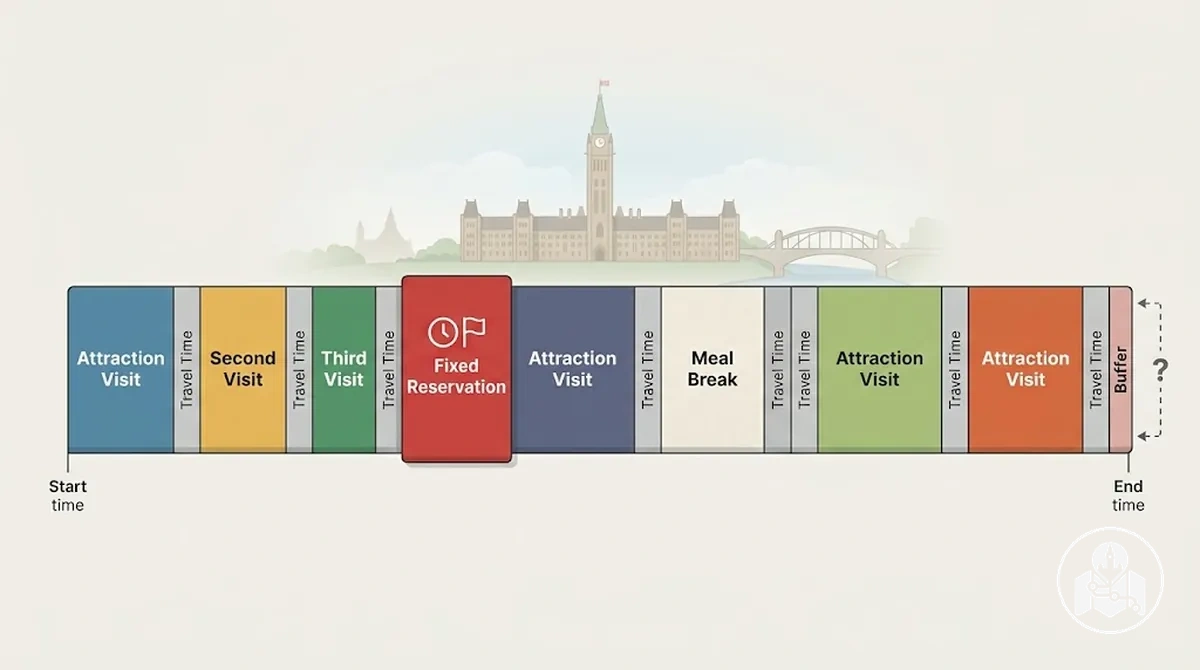
For example, a few long-duration stops can create a heavier schedule than several short clustered stops because each long visit occupies more of the day.
Several short nearby stops may require less travel time, while distant stops or fixed reservations can compress the schedule even when the attraction count is lower.
Daily capacity therefore depends on the combined time burden rather than a universal number of attractions.
How Many Attractions Fit Into an Ottawa Day?
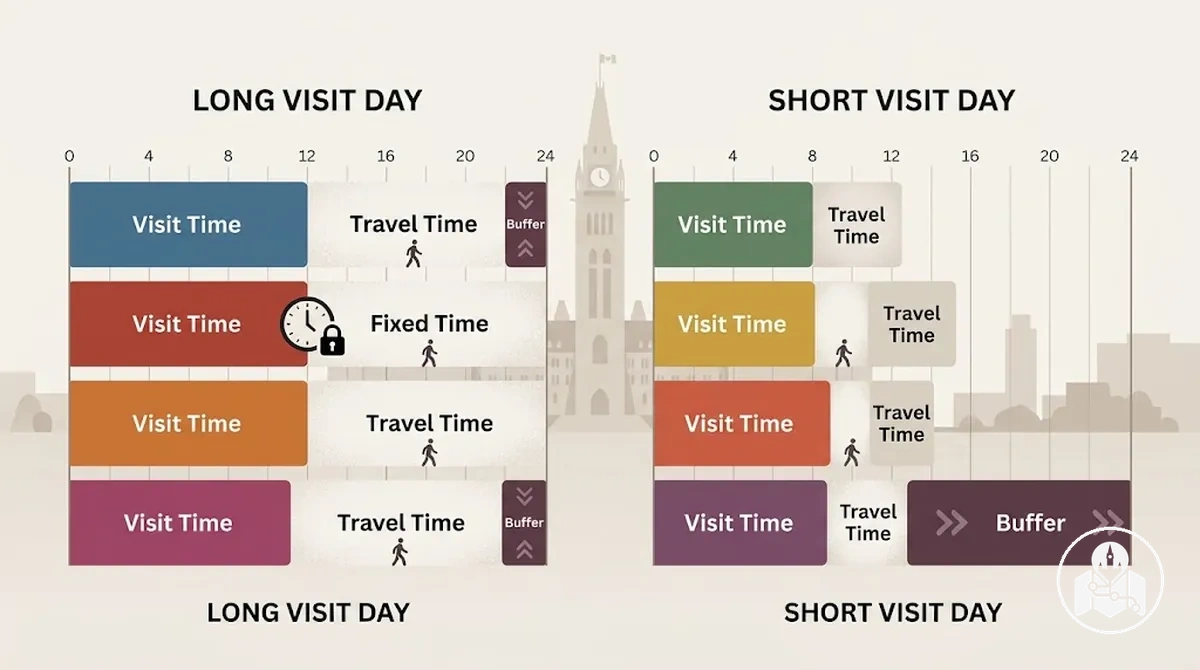
There is no reliable fixed number of attractions per day that fits every Ottawa itinerary because daily capacity changes with visit duration, distance, opening window, transport, traveller pace, and buffer.
A raw daily stop count therefore cannot establish how much sightseeing will fit.
Practical capacity is better assessed by checking how each commitment consumes time or constrains when another stop can occur.
The image compares different capacity conditions rather than recommending a fixed attraction count.
| Criterion | Condition to Check | Effect on Daily Capacity |
|---|---|---|
| Visit duration | How much usable time each attraction requires | Longer visits consume more of the usable day and leave capacity for fewer additional stops |
| Geographic spread | Distance and travel time between sightseeing stops | Greater separation increases transfer time; clustered stops can leave more time for additional visits |
| Fixed access windows | Opening window, reservation time, or another fixed-time stop | Fixed access constrains when other visits can occur and can reduce scheduling flexibility |
| Transport burden | Walking, public transport, transfers, and waiting required between stops | More movement time reduces the portion of the day available for attractions |
| Traveller pace and buffer | Time needed for breaks, meals, slower movement, and unscheduled margin | A slower pace or larger buffer leaves capacity for fewer planned stops but more recovery margin |
For example, a day with a few long-duration visits can carry a greater time demand than a day with several short clustered stops.
The relevant criterion is whether the combined visits, movement, access constraints, breaks, and buffer fit within the usable day with margin.
Scheduling Attractions Without Checking Time Constraints
A sensible Ottawa attraction list can still fail when sightseeing time constraints are checked only after the schedule order is built.
An opening window, timed entry, event start time, expected visit duration, or closing cutoff can restrict when an activity fits even when the activities themselves are reasonable choices.
A fixed constraint limits when an activity can occur, while a flexible activity can move when the day develops differently than planned.
Opening windows, timed entry, event start times, and closing cutoffs can therefore anchor parts of the schedule, while activities without a fixed time may remain flexible around them.
The image below shows this relationship on a simple timeline, including the buffer available between fixed and flexible commitments.
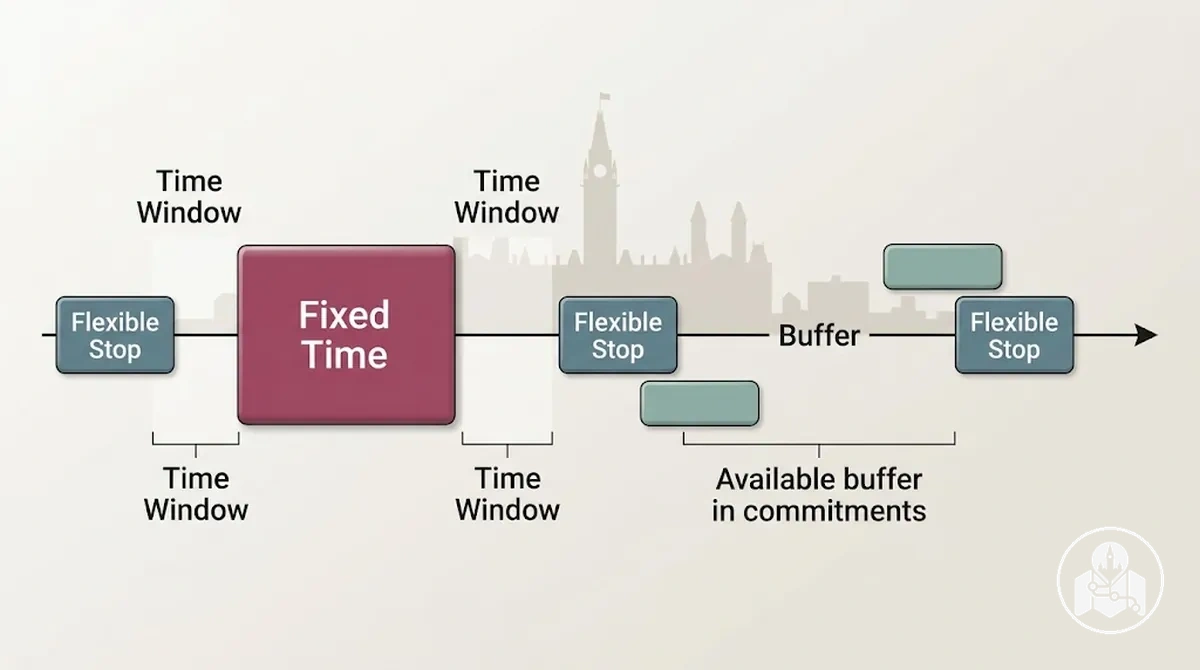
Schedule order should account for fixed constraints before relying on the flexibility of other activities.
Expected visit duration also matters because a flexible stop can still consume enough time to conflict with a later fixed-time stop or closing cutoff.
When a conflict appears, activities with genuine timing flexibility can move around the applicable time constraints rather than forcing every stop into its original position.
Time constraints therefore anchor the schedule where required, while flexible activities provide room to adjust the order.
Ignoring Opening Hours, Timed Entry, and Visit Duration
An Ottawa attraction can appear to fit logically in a day but still be infeasible if its operating window or entry conditions have not been verified.
Opening hours, closing time, last admission, timed entry, and visit duration can determine whether the planned time slot is actually usable.
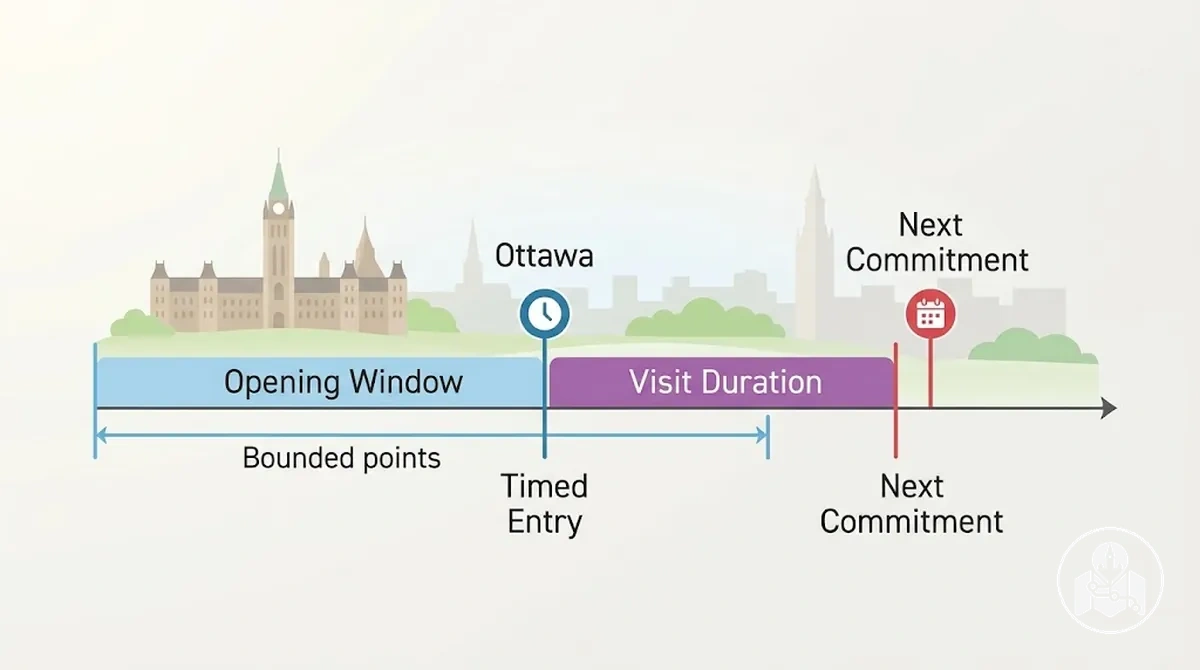
Access availability and usable visit time are separate checks: being open during the intended period does not by itself establish that enough time remains for the visit before the next commitment.
Reservation requirements, timed entry, seasonal availability, and temporary changes can also affect whether an intended arrival is feasible.
The image below shows how an operating window, timed-entry point, visit-duration block, and next commitment can interact without assuming current attraction-specific hours.
- Verify that the intended visit falls within the attraction's opening hours and before its closing time.
- Check whether a last admission applies and whether the intended arrival falls before that cutoff.
- Confirm whether entry requires a reservation or timed entry for the intended time slot.
- Verify seasonal availability and any temporary change that could affect access on the planned date.
- Allow a realistic visit duration so the stop can be completed before the next scheduled commitment.
- Check the arrival margin needed to reach the relevant access or timed-entry window without treating entry as guaranteed.
Because opening hours, entry conditions, and seasonal availability can change by attraction and date, time-sensitive facts should be verified against the attraction's authoritative current information.
A stop should be treated as fixed in the itinerary only after both its access conditions and usable visit time have been checked.
Leaving Too Little Buffer for Queues, Meals, and Delays
Too little buffer time leaves an Ottawa itinerary with limited capacity to absorb ordinary variation.
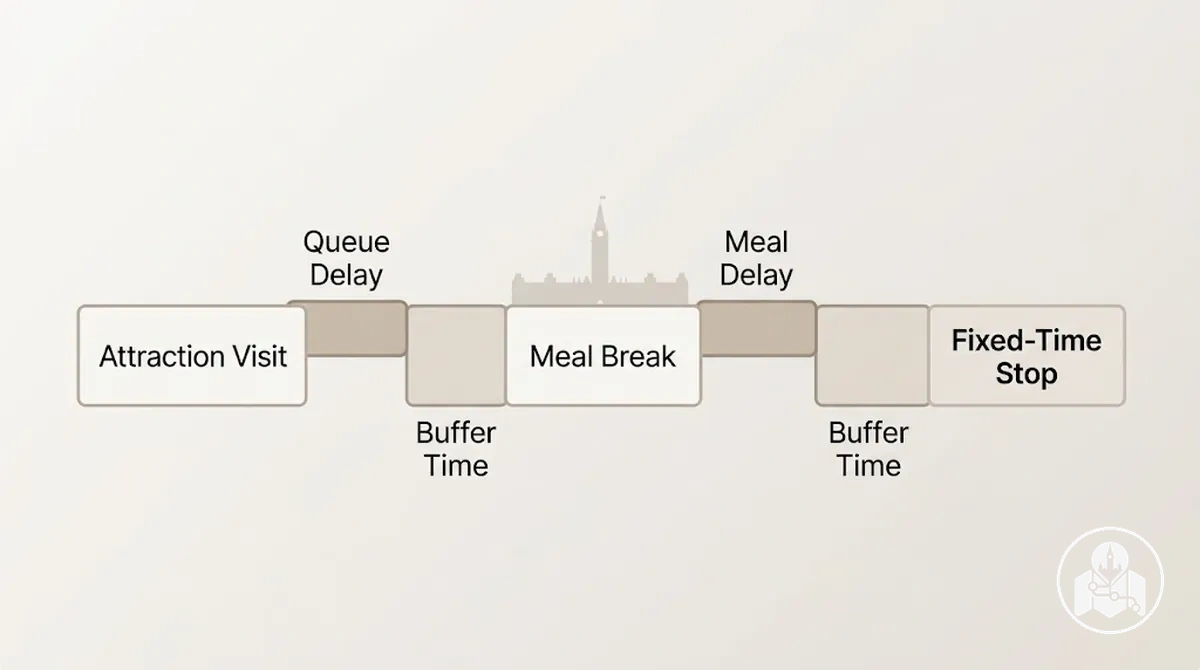
A small queue, longer meal break, navigation delay, or slower transition time can then push later activities behind schedule and affect a fixed-time stop.
Buffer time provides recovery margin for delays that may arise between planned activities rather than predicting an exact delay.
Several ordinary overruns can accumulate, so the image below shows how explicit buffer blocks can absorb variation before it reaches a later fixed-time stop.
- A queue or entry procedure can extend the time required to begin an activity.
- A meal break can take longer than the time implicitly assumed in the schedule.
- Navigation between nearby activities can add an unplanned minor delay.
- Restroom and other personal breaks can consume otherwise unallocated time.
- Ordinary transition time between finishing one activity and starting another can accumulate across the day.
For example, a longer queue followed by a slower meal break and a minor navigation delay can combine into enough lateness to threaten a later fixed-time stop when no recovery margin remains.
The appropriate buffer is conditional rather than a universal fixed number because the useful margin changes with factors such as attraction type, time of day, transport conditions, and the rigidity of reservations.
Underestimating Travel Time Between Sightseeing Stops
Travel time between Ottawa sightseeing stops is a door-to-door time cost, not just the distance or in-motion portion shown between two points.
Walking to the departure point, waiting or parking, the transfer itself, the final walk, and an arrival margin can all affect when the next scheduled activity can realistically begin.
Realistic transfer time should therefore follow the complete movement sequence rather than only the main travel segment.
Each component can add time before the next stop is reached.
Estimating these components together gives a more useful measure of schedule burden than map distance alone:
- Access: Allow for walking from the origin to the place where the next transfer begins.
- Waiting or parking: Account for waiting before departure or the time needed to park when applicable.
- Travel: Include the main walking or transport segment between the two areas.
- Final walk: Include movement from the arrival point or parking location to the attraction entrance.
- Arrival margin: Allow for the gap needed between completing the transfer and reaching the next scheduled activity.
Geographically scattered stops can create a larger schedule burden because the door-to-door sequence repeats across longer or less direct movements, while a compact cluster of nearby attractions can reduce avoidable transfer time.
One way to reduce travel time by grouping attractions is to keep nearby stops together instead of repeatedly crossing between separate areas.
Actual transfer duration still depends on conditions such as walking pace, waiting, parking, traffic, and route conditions, so schedule feasibility should be judged using the full door-to-door estimate rather than map distance alone.
Choosing Transport After the Daily Route Is Already Fixed
Transport choice for an Ottawa itinerary should be tested against the daily route before the sightseeing sequence is fixed.
A mode that fits one route may make another sequence less practical because walkability, transit transfers, parking, weather exposure, accessibility needs, and fixed-time stops can change the scheduling burden.
Mode choice depends on both route conditions and traveller needs, so each condition should be checked for its effect on order and buffer:
- Walkability: A route with comfortably walkable distances may support a simpler sequence, while longer or less practical walking segments can require a different order or more buffer.
- Transit transfers: A route requiring a transit transfer or additional waiting can reduce scheduling flexibility, especially before a fixed-time stop.
- Parking or pickup friction: Time needed to find parking, reach a pickup point, or access the next stop can make an otherwise direct sequence less practical.
- Weather exposure: Conditions that make prolonged outdoor movement less suitable can change whether walking fits the route and may alter the required schedule margin.
- Accessibility: Mobility and accessibility needs can affect which travel mode fits the route and how much time should be allowed between stops.
- Fixed-time reliability: When the route includes a fixed-time stop, the selected mode should leave enough buffer for conditions that could affect arrival.
For example, the same attraction sequence may work with one order when walking is practical but require a different order or larger buffer when transit transfers or parking are involved.
Transport suitability is therefore route-specific rather than universal; for deeper mode planning, plan transport before finalizing your route.
Transport choice can change the required order or buffer without making one mode universally superior.
Planning a Weather-Sensitive Day Without Flexibility
A weather-sensitive Ottawa itinerary becomes fragile when too many activities depend on the same outdoor conditions and no flexibility exists to change timing or substitute another activity.
Forecast uncertainty means a workable plan should not depend on one weather outcome remaining unchanged.
Weather sensitivity varies by activity type and by the conditions that affect access, comfort, movement, or seasonal operation.
These criteria help identify where a backup plan or movable block is most useful:
- Outdoor dependence: An outdoor activity that relies heavily on suitable conditions may need a flexible time slot or an indoor alternative if conditions change.
- Seasonal conditions: Condition-dependent or seasonal activities may have different operating or feasibility limits, so current information should be verified before treating them as fixed.
- Travel disruption: Weather may affect movement between stops, making tightly connected commitments less practical when extra travel time or route changes are required.
- Fixed reservations: A weather-sensitive commitment with a fixed time offers less flexibility, so surrounding activities may need to remain movable.
- Fallback availability: Indoor alternatives or activities that can be rescheduled allow substitution when an outdoor block becomes unsuitable.
Winter conditions can materially change outdoor feasibility, travel disruption, and the time needed to move between activities, but the effect depends on current conditions and the specific activity.
When those factors matter, adapt an itinerary for winter rather than assuming a normal-season schedule will transfer unchanged.
Preserving at least one flexible block allows a weather-sensitive activity to move without forcing the rest of the day to be rebuilt.
Wet weather can create the same planning issue when several outdoor activities depend on similar conditions.
If rain changes which activities remain practical, prepare for rainy weather by keeping an indoor alternative or movable activity available as a fallback.
The purpose is flexibility, not predicting whether a particular weather outcome will occur.
How to Rebalance an Ottawa Itinerary After a Planning Error
A practical first repair after an Ottawa itinerary planning error is usually to reduce or move commitments before trying to compress every activity.
Rebalancing works best when the cause of infeasibility is identified first, because overload, fixed-time conflict, travel inefficiency, and lost buffer require different corrective directions.
The diagnostic table separates common failure patterns before changes are made.
Use the symptom to identify the likely planning cause, check the constraint behind it, and then choose the smallest change that can restore a workable revised day.
| Problem Sign | Likely Planning Cause | Check | Corrective Direction |
|---|---|---|---|
| Several activities feel rushed or no longer fit | Overload | Check whether the combined commitments exceed the usable time available | Reduce the load or move a lower-priority attraction rather than compressing every stop |
| A reservation or other fixed commitment conflicts with surrounding activities | Fixed-time conflict | Identify which commitments are hard constraints and which remain flexible | Protect the fixed commitment and reschedule movable activities around it |
| Too much of the day is being consumed by movement | Travel inefficiency | Check whether the route creates unnecessary travel between otherwise reasonable stops | Reduce avoidable movement by changing the sequence or moving a commitment |
| Small delays repeatedly threaten later activities | Insufficient buffer | Check whether the revised day has enough margin to absorb ordinary variation | Create more recovery margin by reducing or moving commitments |
After the cause is identified, protect fixed commitments and other hard constraints, make the smallest necessary change, and then verify the revised day against time, movement, and available margin.
The goal is not to preserve every original stop at all costs, but to restore feasibility with the least disruption.
For example, a day that originally contains too many commitments may become workable after one lower-priority attraction is rescheduled and the remaining fixed-time stop is protected.
If the planning error reveals that the whole day structure needs to be rebuilt rather than locally adjusted, the broader Ottawa travel itineraries context can provide that boundary.
The revised day is successful when it is feasible, not when every original commitment remains unchanged.
Protect Fixed-Time Stops Before Flexible Activities
Fixed-time commitments should generally be protected first when missing them would materially reduce the planned experience and when they are difficult to replace.
A reservation or timed activity is not automatically the highest priority; traveller priority, replaceability, and practical flexibility also determine what should remain anchored.
Fixed-time status is only one part of the decision.
The criteria below show how time rigidity, alternatives, traveller value, and downstream scheduling cost affect which activity should stay fixed:
- Time rigidity: A fixed-time stop with little timing flexibility is more likely to remain an anchored activity than one that can move within a wider window.
- Reservation status: A reservation can increase rigidity, but it deserves protection only when changing or missing it would materially affect the plan.
- Alternative slot: A timed activity with another practical slot is easier to reschedule than a commitment with no workable replacement time.
- Traveller priority: A hard-to-replace activity that is important to the traveller has a stronger case for protection than a lower-priority commitment with similar time rigidity.
- Downstream cost: If moving one commitment would force several other activities to shift, its downstream cost is higher and keeping it anchored may preserve more of the revised schedule.
A hard-to-replace fixed-time stop with high traveller priority and no useful alternative slot is usually less flexible than an easily movable activity with several replacement options.
The commitment with the least practical flexibility and the highest value under the traveller's priorities should generally remain anchored.
Remove or Reschedule Lower-Priority Attractions
Once overload is confirmed, the next step is to identify which lower-priority attraction creates the most scheduling friction rather than simply removing the least important-looking stop.
The goal is to protect higher-value activities while reducing time cost, poor geographic fit, or inflexible commitments that make the revised day harder to execute.
Use the sequence below to decide whether a candidate activity should be removed or rescheduled:
- Assess traveller value and rigidity: Compare the lower-priority attraction with higher-value activities, then check its reservation flexibility and whether an alternative slot exists.
- Assess scheduling burden: Consider its time cost, geographic fit, and effect on route efficiency. A stop that requires a large detour or disrupts several nearby activities creates more friction than one that fits naturally into the route.
- Choose remove or reschedule: Remove the activity when keeping it would continue to overload the day and no practical later slot exists; reschedule it when a later time or day offers a cleaner geographic fit or more flexibility.
- Verify the improvement: Check that the change protects higher-value activities and improves the timing or route efficiency of the remaining schedule.
For example, removing one lower-priority attraction that sits far from the rest of the day's route may protect several higher-value activities by reducing travel time and schedule friction.
If that attraction has good reservation flexibility or a better geographic fit later in the trip, rescheduling may preserve it without weakening the revised day.
Recheck Travel Time and Recovery Buffer Before Finalizing the Day
A revised Ottawa itinerary is not finished until the updated route, timing, and recovery buffer are rechecked together.
Removing one stop does not confirm feasibility if the remaining travel time, visit duration, breaks, and fixed commitments still leave too little margin.
The final check should combine the main timing conditions that determine whether the revised day still works as one connected schedule:
- Door-to-door travel time: Recalculate the movement time between remaining stops so the revised route reflects the full transfer burden.
- Arrival margin: Recheck the margin before each fixed commitment rather than assuming a lower attraction count creates enough time automatically.
- Visit duration: Confirm that each remaining activity still has a realistic duration within the updated schedule.
- Meal or rest time: Keep the meal break or other rest time visible in the revised day instead of treating it as unused recovery time.
- Remaining slack: Check whether a recovery buffer remains after travel, visits, and breaks are included.
For example, a revised day may look lighter after one attraction is removed but still remain fragile if longer travel time or visit duration consumes most of the recovered space.
The revised day remains feasible only when ordinary variation can be absorbed by the remaining slack without immediately breaking a later fixed commitment.