
Ottawa Self-Guided Walking Itinerary
Follow the downtown route from Parliament Hill through the central Rideau Canal area to ByWard Market. Reverse the direction when your arrival point, current access, or preferred endpoint makes ByWard Market the more practical start, and plan total outing time as walking plus stops, queues, pauses, and any detour.
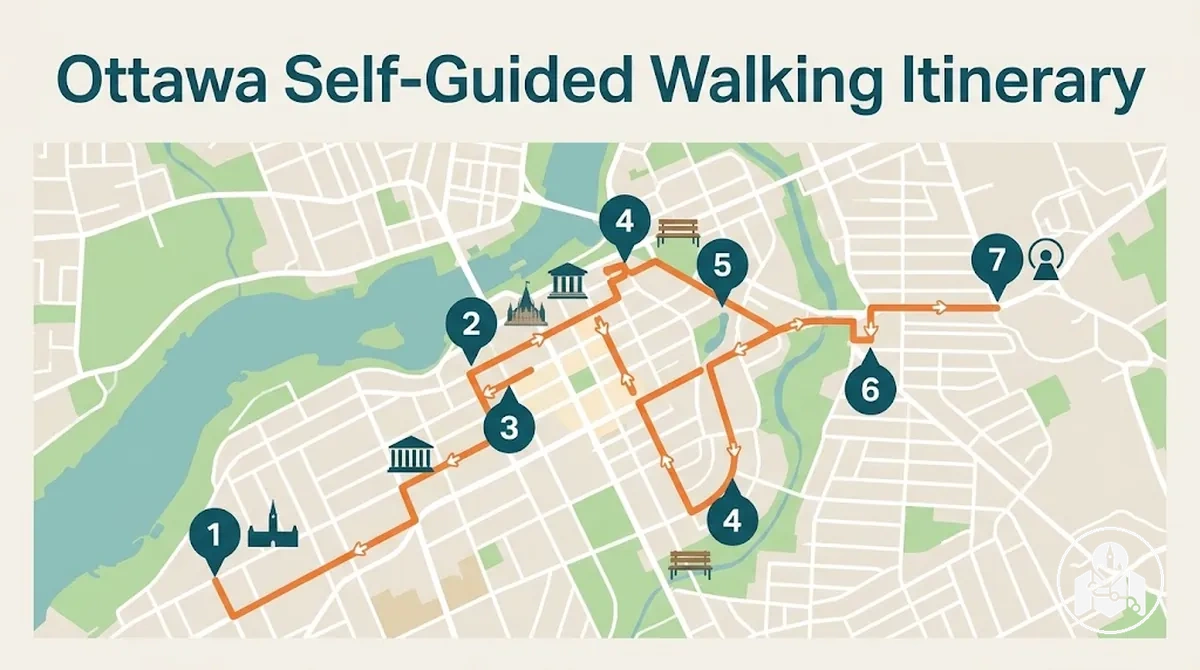
Downtown walking route at a glance
Keep the three route anchors in a continuous sequence, then adapt direction and optional time to the conditions on the day.
- Parliament HillRoute origin in the default direction
- Central Rideau Canal areaConnecting orientation segment
- ByWard MarketCore route endpoint
- Direction
- Use the default order when Parliament Hill is the practical start; reverse it when arrival, access, or endpoint convenience favours ByWard Market.
- Before departure
- Confirm current access and closures, then allow time for sightseeing stops as well as active walking.
- Timing
- Total elapsed time includes active walking, stops, pauses and queues; detours can add both distance and walking time.
- Adjusting the walk
- With less time, reduce optional dwell or side detours first. With more time, add only nearby stops that allow a natural return to the route.
This is a downtown Ottawa route, not a claim that every part of Ottawa is practical to explore on foot or that one fixed street-level path is always available.
Table of Contents
Plan the Ottawa Walking Route Before You Start
Before starting the Ottawa walking route, choose the start point and walking direction, set an available-time allowance, and check route access for the day of the walk.
Treat the start point and direction as route choices that preserve route continuity. Treat walking time, stop time, pace, access, and detours as separate timing conditions so the route order is not built around an unrealistic duration.

The route is ready to follow once the start point, walking direction, available-time allowance, route-access check, and stop-time allowance are settled.
Broader trip sequencing belongs with Ottawa travel itineraries; this planning step remains limited to preparing the walking route for departure.
Choose a Starting Point and Walking Direction
Choose the starting point and walking direction that preserve route continuity and reduce backtracking.
The default order starts at Parliament Hill, continues via the Rideau Canal, and finishes at ByWard Market. Use that sequence when Parliament Hill is practical to reach and ByWard Market is a convenient endpoint.

What changes the direction choice
- Access to the first stop: choose a starting point that is practical to reach from your arrival point.
- Route continuity: keep Parliament Hill, the Rideau Canal, and ByWard Market in a continuous order rather than repeatedly reversing direction between route anchors.
- Endpoint convenience: consider where you need to finish the walk when choosing the walking direction.
- Backtracking cost: prefer the direction that avoids unnecessary retracing between the route anchors.
Reverse the default sequence when your arrival point, route access, or preferred endpoint makes ByWard Market the more practical starting point; the core corridor can then run through the Rideau Canal toward Parliament Hill without becoming a separate itinerary.
If you need to group walkable Ottawa attractions, use that broader area context separately rather than changing the route orientation solely to add more stops.
The direction is a practical choice, not a mandatory rule: base it on arrival access, route continuity, and where you need to finish.
Check the Route Distance and Walking Time
Separate walking distance, active walking time, and total elapsed time; they measure different parts of the outing.
- Walking distance
- The length of the route actually followed.
- Active walking time
- The time spent moving on foot along that route.
- Total elapsed time
- Active walking plus sightseeing stops, pauses, queues, and other interruptions.
Do not assume one fixed distance or duration for this itinerary. The available path, access conditions, detours, and stop pattern can change, so use the distance and walking-time estimate for the route you can actually follow on the day, then add stop and waiting time separately.

Route practicality depends on your available schedule and the conditions that affect total elapsed time.
What changes the total outing time
- Walking pace: a slower pace increases active walking time for the same route length.
- Stop duration: longer sightseeing stops add to total elapsed time without changing the planned walking distance.
- Pauses and queues: waiting or resting extends total elapsed time even when the route itself remains unchanged.
- Detours and access changes: a temporary change in the intended path can increase both walking distance and walking duration.
Judge route practicality by whether your available time can accommodate both active walking time and the additional time expected for stops, pauses, queues, or detours.
If the resulting walking commitment does not suit your schedule or conditions, compare walking with other transport rather than relying on an unsupported fixed duration for the route.
Follow the Downtown Route from Parliament Hill via the Rideau Canal to ByWard Market
The downtown Ottawa walking route follows one continuous sequence: Parliament Hill → central Rideau Canal area → ByWard Market.
These three anchors form the route spine, while the precise walking connection between them can change with current access conditions. The sequence below shows the directional relationship rather than exact turn-by-turn directions.

- Parliament Hill: start the downtown route here, then orient the next route transition toward the central Rideau Canal area.
- Central Rideau Canal segment: use the canal area as the connecting route stage, then continue toward ByWard Market.
- ByWard Market: finish the three-stage walking sequence here after approaching from the central canal area.
Use each major anchor as an orientation cue rather than relying on an assumed street-level path between stages.
An access condition, temporary closure, or detour can alter the exact transition without changing the intended anchor order. Check current access conditions before depending on a specific path.
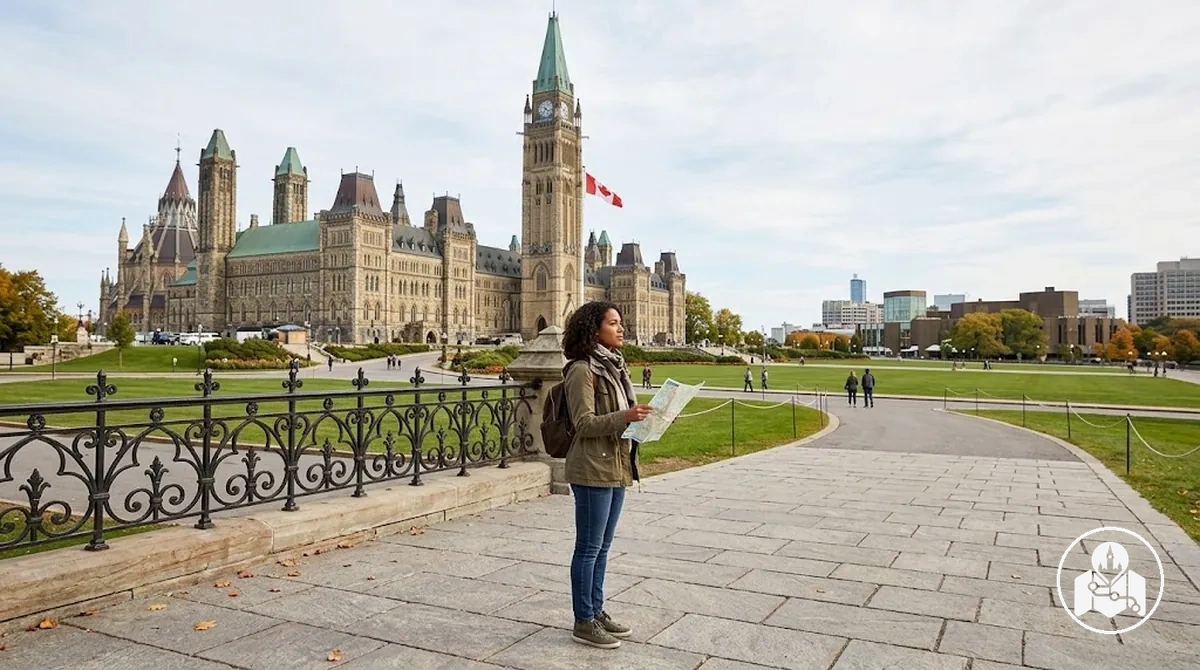
Start at Parliament Hill
Begin the walking itinerary at Parliament Hill, which serves as the route origin in the default direction.
- Route role
- Use Parliament Hill as the starting orientation cue for the downtown walk.
- Departure cue
- Set your onward direction toward the central Rideau Canal area rather than relying on one specific entrance or street-level path.
- Access condition
- Choose an access point that is available when you arrive; a restriction, temporary closure, security condition, or route change can alter how you leave the area.
- Schedule effect
- Time spent pausing at Parliament Hill adds to total elapsed time before you continue.
Once the departure direction is clear, continue toward the central Rideau Canal area as the next orientation cue.
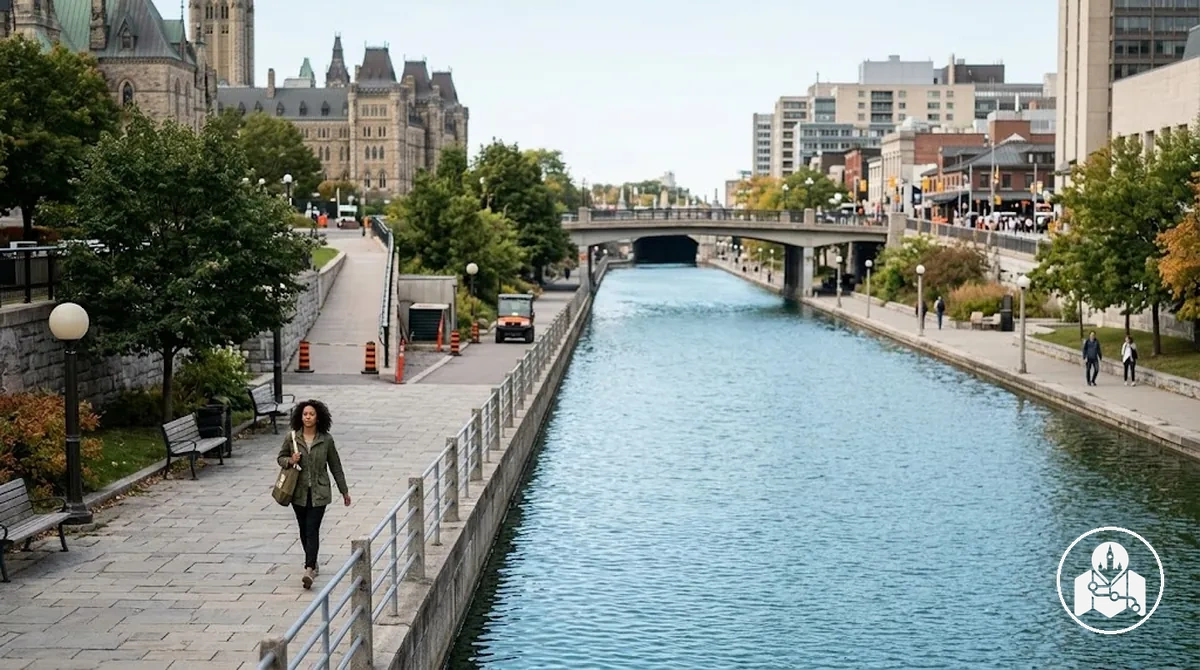
Continue via the Rideau Canal
Use the central Rideau Canal area as the connecting segment between Parliament Hill and ByWard Market.
- Route role
- The canal area connects the Parliament Hill stage with the onward approach to ByWard Market.
- Orientation
- Keep the canal as the main cue through this central segment without assuming one exact path is permanently available.
- Scope
- This itinerary uses only the relevant downtown segment; it does not require following the wider Rideau Canal network.
- Street-level path
- Exact turns and path names are not fixed by this itinerary. Confirm current access and adapt the connection if a closure or detour affects the intended path.
Leave the canal segment in the onward direction toward ByWard Market.
Finish the Route in ByWard Market
ByWard Market is the endpoint of the core walking sequence. Reaching the market area completes the planned route.
- Route status
- The core walk is complete when you reach ByWard Market.
- Dwell time
- Time spent in the market after arrival is optional and adds to the outing without creating another required route stage.
- Next move
- Stay if your schedule allows, or finish the walk there if time is limited; travelling elsewhere afterward is a separate onward plan.
Adjust the Walking Itinerary to Your Available Time
Adjust the walking itinerary by preserving the core route spine while changing how you use your available time. Parliament Hill, the Rideau Canal connection, and ByWard Market remain the stable anchors.
The amount you can add or reduce is not fixed because walking pace, access conditions, queues, and detours can alter the schedule.
Less available time
Preserve the core route and reduce optional dwell time, side detours, or nearby additions before changing the route spine.
More available time
Preserve the core route and allow additional dwell time or a nearby optional stop when conditions, schedule, and route re-entry remain practical.
A slower pace, queues, detours, closures, or access changes can increase total elapsed time in either case.
This adjustment applies only to the walking route. If you need to coordinate the walk with other activities across the day, see the one-day Ottawa itinerary instead of expanding this route into a broader schedule.
Shorten the Route Without Unnecessary Backtracking
To shorten the route, reduce optional time costs before changing any core route connection. Start with dwell time, then remove a side detour or nearby addition only when the core anchors remain connected without unnecessary backtracking.
The amount of time saved depends on the specific stop, dwell time, or detour removed, so no fixed saving should be assumed.
- Reduce optional dwell time: shorten pauses at non-essential stops to reduce total time while keeping the core walking connection intact.
- Remove optional side detours: cut a side detour when it adds time without supporting the connection between the core anchors, particularly when it would create unnecessary backtracking.
- Remove optional nearby additions: omit extra nearby stops that add walking or stopping time without supporting the core route sequence.
After making the cuts, verify that the shortened route still connects the core anchors coherently and that the removed stop or detour produces useful time savings for your actual schedule.
If a proposed cut breaks route continuity or creates new backtracking, preserve that connection and reduce a different optional time cost instead.
Extend the Walk Without Breaking the Downtown Sequence
To extend the walk, add a nearby stop that stays close to the existing downtown corridor and allows you to rejoin the route naturally. The addition should remain subordinate to the core route and preserve forward movement toward the endpoint.
Check an optional addition against four criteria
- Proximity to the route: choose a nearby stop close to the existing corridor so the route extension remains connected to the core walk.
- Detour cost: evaluate how far the addition pulls you away from the route, because a larger detour can make route re-entry less direct.
- Extra time required: account for additional walking time and dwell time at the added stop; the scheduling effect depends on the specific addition and current conditions.
- Ease of route re-entry: confirm that the addition allows you to rejoin the route naturally and continue the downtown sequence toward the endpoint without unnecessary retracing.
Before confirming the addition, evaluate its extra time and detour cost against your schedule. If the stop requires substantial backtracking or disrupts forward movement, leave it out and preserve the established downtown sequence.