
Day 1 · Central Ottawa
- Parliament Hill and nearby civic landmarks
- National Gallery of Canada
- Major's Hill Park and ByWard Market
- Rideau Canal and Ottawa River views
Two days in Ottawa can be enough for a focused first visit when nearby sights are clustered and scheduled tours or substantial indoor visits are treated as fixed anchors. Use Day 1 for Parliament Hill, the National Gallery of Canada, ByWard Market, and the Rideau Canal–riverfront area; use Day 2 for one major museum, the Glebe, and Dow's Lake, with outdoor stops and the final evening kept flexible.
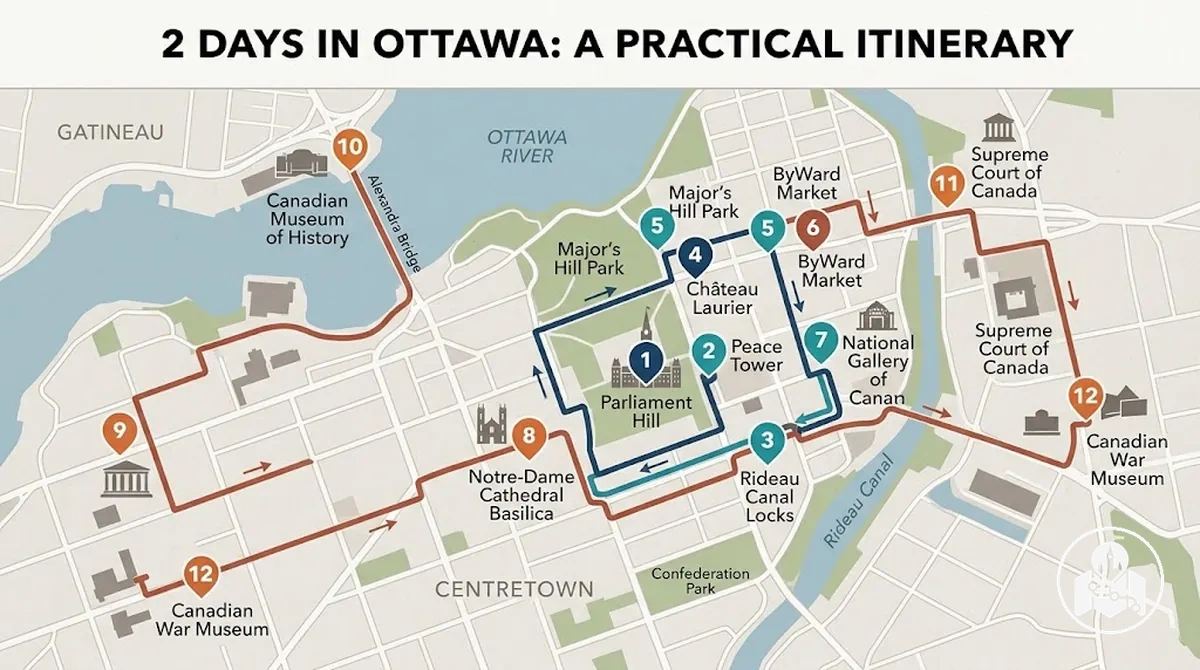
Two-day route planner at a glance
Build each day around the least-flexible commitment, then let nearby outdoor or neighbourhood stops absorb changes in time, weather, queues, and energy.
Day 1 · Central Ottawa
Day 2 · Museum to lakeside
Available sightseeing hours and attraction proximity determine how much transfer time the route consumes, while a long museum visit or scheduled access reduces capacity for other stops.
Opening or tour constraints, meal breaks, weather, queues, and walking tolerance can change the practical sequence, so this itinerary is intentionally selective rather than an attempt to cover every Ottawa attraction.
Two-day Ottawa pacing should centre on priority sights, route proximity, and realistic visit duration rather than the maximum number of stops.
Fixed anchors, nearby flexible stops, and buffer time help distribute that capacity across both sightseeing days.
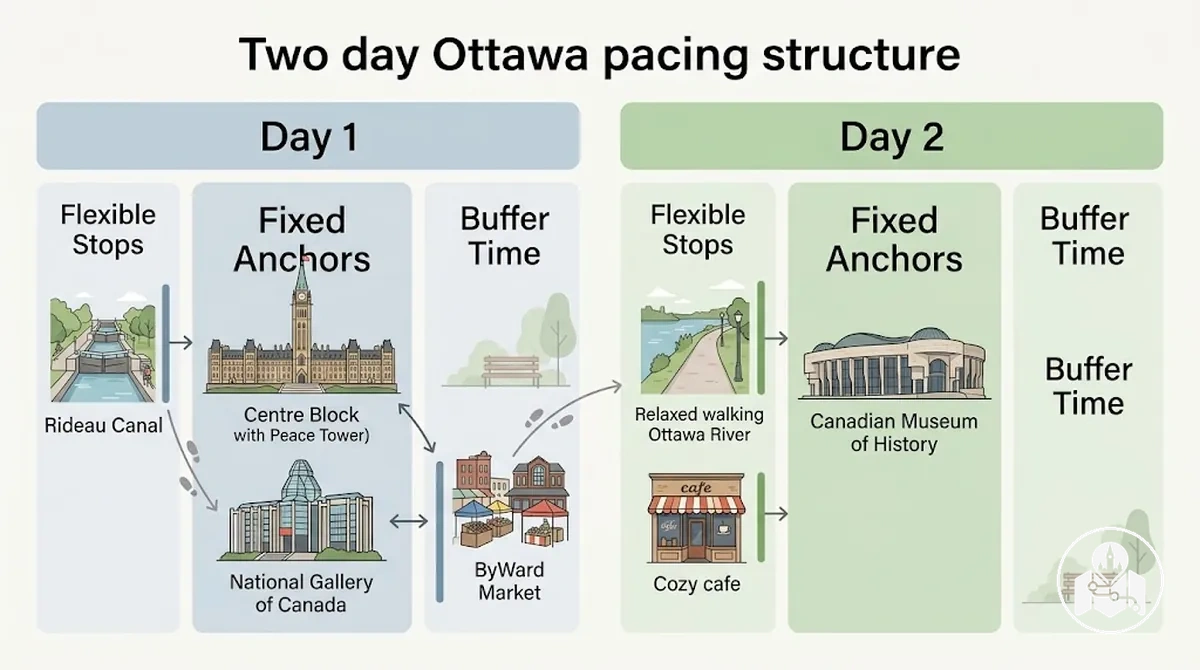
Available hours set the overall time budget, while a long museum visit or scheduled access reduces capacity for other stops.
Clustered sights reduce unnecessary backtracking compared with scattered stops, especially when much of the route involves walking.
Travellers deciding whether the available time suits their priorities can compare one, two and three days in Ottawa separately from pacing the two-day plan itself.
The following criteria show how each planning constraint changes daily capacity and route efficiency.
For a first-time visitor, a small set of priority anchors with flexible secondary stops protects the plan when access, weather, or walking pace changes.
The daily starting point can also affect route efficiency, so travellers who need to resolve that separate planning choice can choose where to stay for sightseeing.
Keeping secondary stops flexible preserves buffer time and makes the two-day route more realistic.
Day 1 follows a compact central Ottawa route anchored by Parliament Hill, ByWard Market, and the Rideau Canal.
The route groups major civic, cultural, park, market, canal, and riverfront contexts while limiting unnecessary cross-city movement.
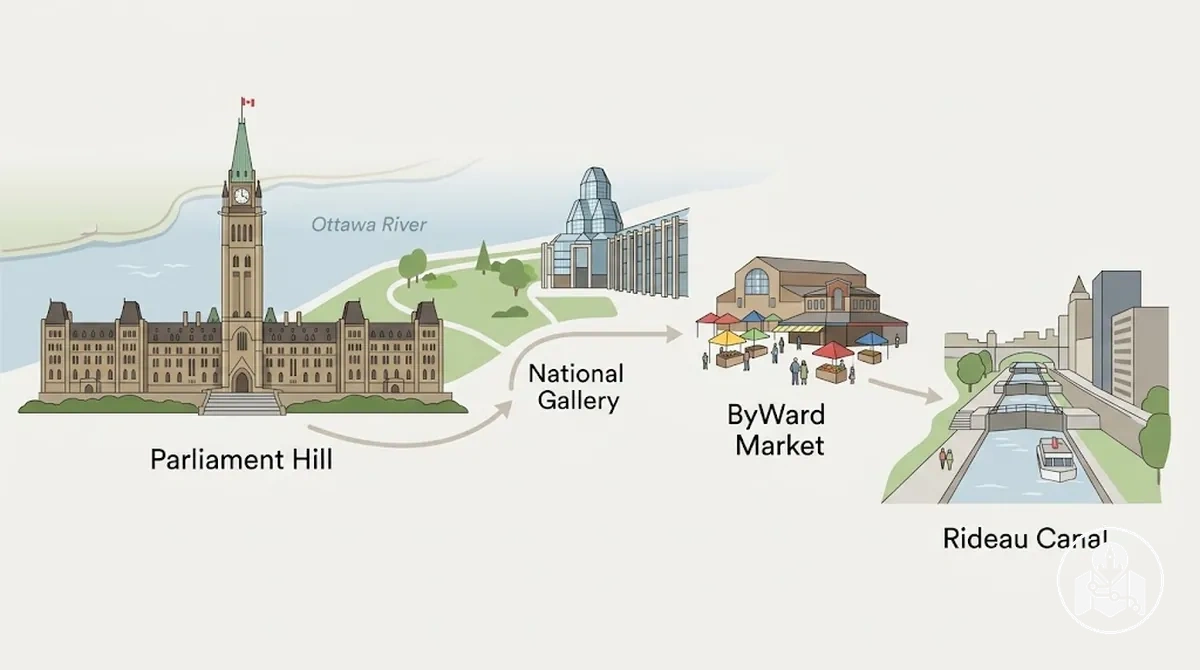
The central grouping connects Parliament Hill and nearby civic landmarks such as the National War Memorial with the National Gallery, Major's Hill Park, and ByWard Market before reaching the Rideau Canal and Ottawa River context.
Indoor visits can require more time and depend on scheduled access, while parks, waterfront areas, and other outdoor connectors can absorb schedule variation more easily.
This route logic keeps nearby stops together without assuming every attraction will fit under the same conditions.
Exact timing should remain flexible because current access, queues, weather, and personal pace can change the practical sightseeing sequence.
Start the morning at Parliament Hill, then add only nearby downtown landmarks that fit the walking route without a meaningful detour.
The sequence follows proximity and any time-sensitive tour access rather than treating every civic landmark as a required stop.
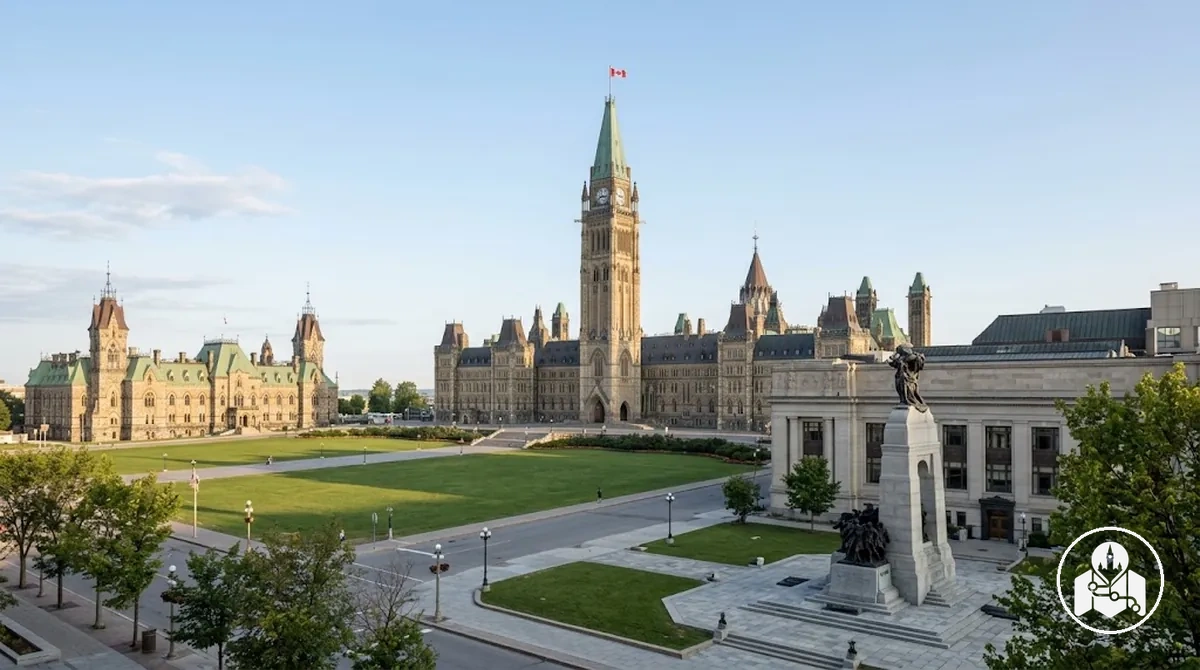
Interior access can increase dwell time and make the route less flexible, while exterior sightseeing provides a practical fallback when a tour or building visit does not fit.
Keep exact timing conditional on current availability, queues, walking pace, and the time actually spent at each stop.
Make the National Gallery of Canada the longer indoor anchor for the afternoon, then continue through Major's Hill Park to ByWard Market as lighter, more flexible nearby stops.
The sequence uses proximity to balance a substantial art visit with an outdoor connector and a market stop that can contract if the Gallery visit duration runs longer.
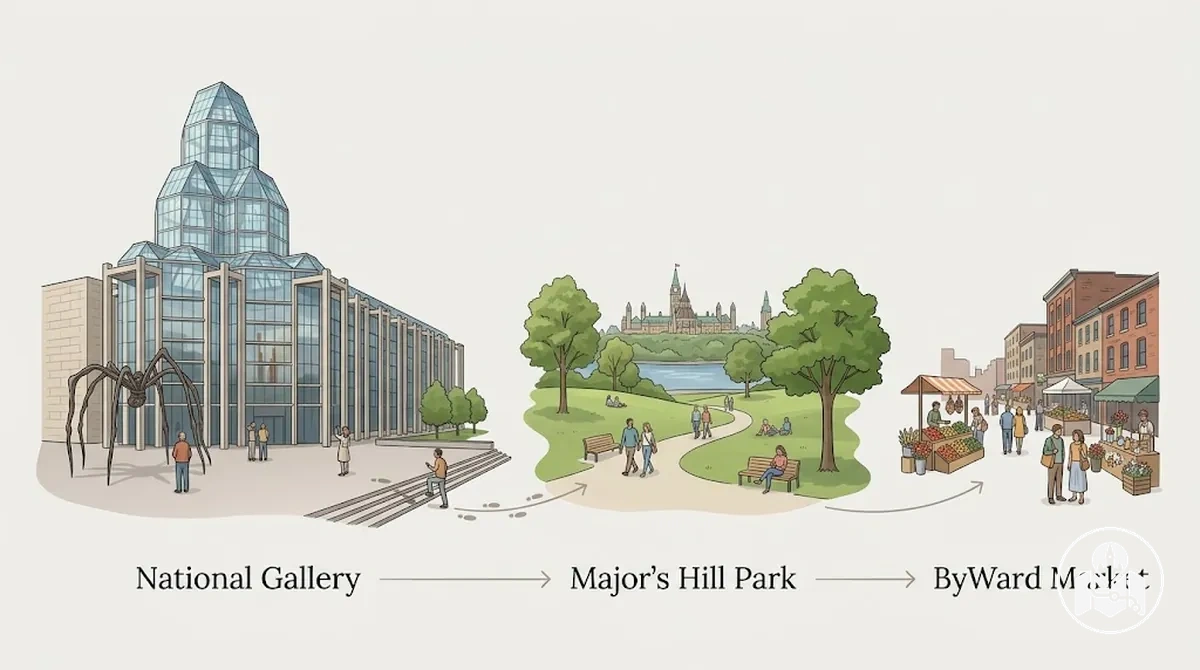
The afternoon should adapt around the National Gallery rather than assigning equal time to all three stops.
If visit duration, weather, meal timing, or energy level changes the plan, Major's Hill Park and ByWard Market provide the flexible portions that can receive more or less time while preserving the approved sequence.
After a full sightseeing day, use the Rideau Canal and Ottawa River waterfront for a lower-complexity evening finish rather than another time-intensive attraction.
The waterfront setting allows the walk to expand or contract around current conditions.
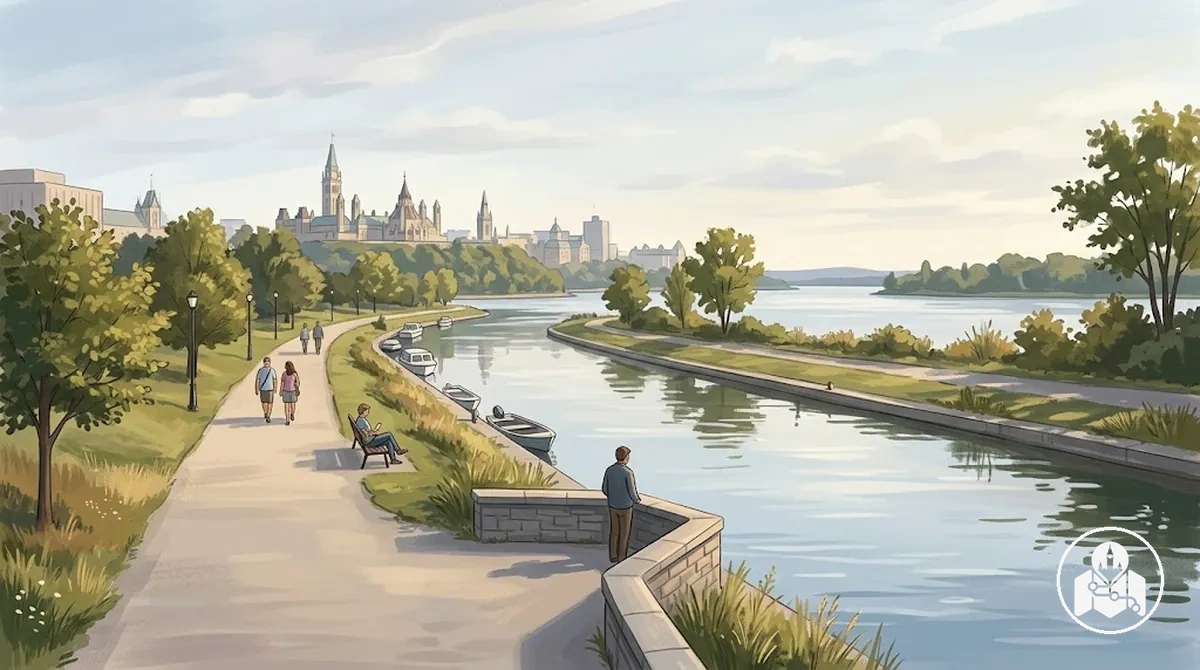
Adjust the evening to the conditions
Extend the waterfront walk when
Result: spend longer along the canal or waterfront and allow more time for Ottawa River views.
Shorten the finish when
Result: use a shorter, viewpoint-focused finish near the central route.
Keep the exact route length flexible so the day can end comfortably without depending on a fixed sunset activity.
Day 2 uses one major museum as the morning anchor, followed by the Glebe and Dow's Lake as a more flexible afternoon segment.
This sequence balances a time-heavy indoor visit with neighbourhood walking and lakeside activity that can expand or contract around actual conditions.
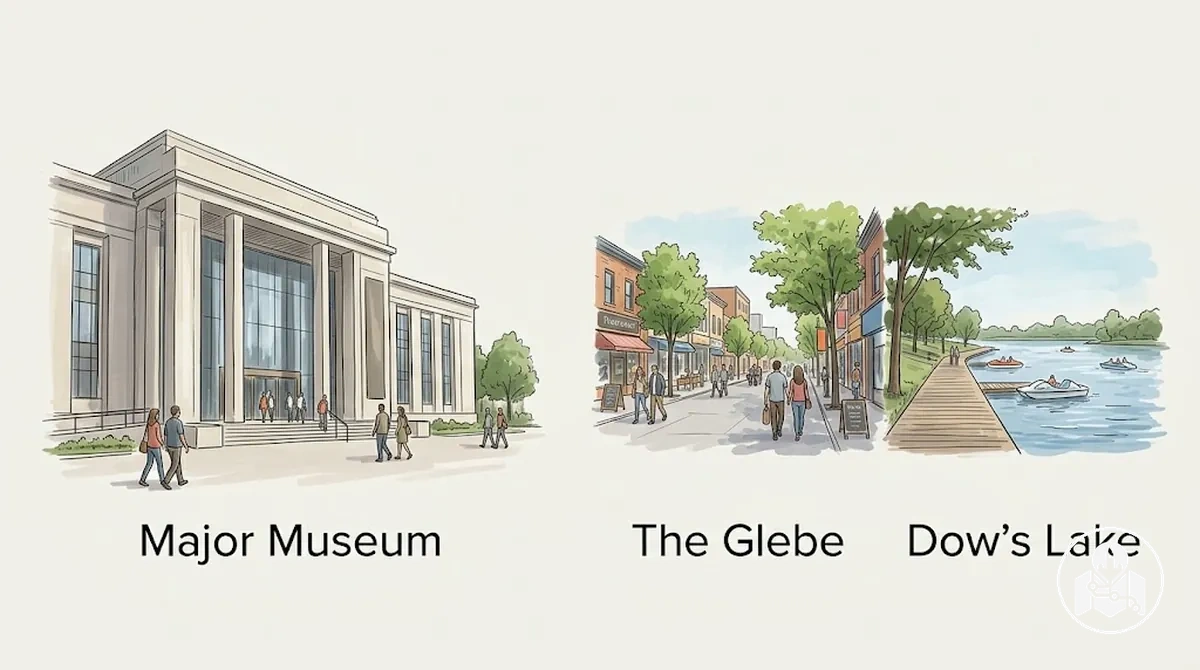
Museum duration and route fit determine the time budget left for the Glebe and Dow's Lake, while access constraints can further compress the afternoon.
Favourable weather and comfortable walking tolerance can support a longer neighbourhood or lakeside segment; less suitable conditions can shorten it.
The second-day route therefore retains the same museum-to-Glebe-to-Dow's Lake logic while allowing the later activities to adapt to actual time and conditions.
Choose one major museum for the morning based on subject interest, route fit, likely time commitment, and current access rather than a universal ranking.
The Canadian Museum of History, Canadian Museum of Nature, and Canadian War Museum can be compared on the same criteria, including subject focus, route position, time demand, and scheduling considerations.
| Museum | Subject focus | Route fit | Likely time commitment | Scheduling considerations |
|---|---|---|---|---|
| Canadian Museum of History | Canadian history and related cultural history | Across the Ottawa River in Gatineau, so the afternoon requires a cross-river transition before continuing toward the Glebe and Dow's Lake. | Plan it as the morning's main commitment; a broader gallery visit can use most of the morning, while a more selective visit preserves afternoon flexibility. | Verify current access, opening information, ticketing requirements, and relevant special exhibitions before fixing the schedule. |
| Canadian Museum of Nature | Nature and natural history | In central Ottawa, with a relatively direct southward transition toward the Glebe and Dow's Lake for the afternoon segment. | Plan it as the morning's main commitment; selected galleries can keep the visit focused when more time is needed for the afternoon route. | Check current access, opening information, ticketing requirements, and special exhibitions when setting the morning plan. |
| Canadian War Museum | Canadian military history | At LeBreton Flats west of downtown, so the plan should allow for the onward transition toward the Glebe and Dow's Lake after the museum. | Plan it as the morning's main commitment; prioritising selected exhibits leaves more flexibility for the later neighbourhood and lakeside segment. | Confirm current access, opening information, ticketing requirements, and relevant special exhibitions before relying on a specific schedule. |
A history-focused, nature-focused, or military-history-focused interest can narrow the choice, but route fit and available time still affect how comfortably the afternoon can follow.
A longer museum visit can compress the later schedule, while a shorter visit can leave more flexibility.
Current opening hours, ticketing arrangements, and special exhibitions can change.
Verify those details with the relevant museum before treating the morning schedule as fixed.
Move through the Glebe toward Dow's Lake as one connected afternoon route rather than treating the area as separate stops.
Keep nearby stops together so proximity and walkability reduce unnecessary travel while leaving room for food, walking, and a slower lakeside finish.
Walkability, proximity, weather, energy level, and daylight determine how much of the Glebe-to-Dow's-Lake sequence comfortably fits.
Combining nearby stops helps reduce unnecessary travel, and travellers can plan Ottawa sightseeing by area using the same implementation principle.
For example, poor weather or a longer museum visit can compress the route to a shorter Glebe and Dow's Lake segment.
The route remains geographically coherent because the afternoon still progresses through the same local area rather than adding disconnected stops.
Treat the final hours as a controlled flexibility block rather than another mandatory sightseeing slot.
The best use of this time depends on remaining time, fatigue, weather, reservations, and any missed priority from earlier in the itinerary.
Remaining time, fatigue, weather, reservations, and earlier delays determine whether the final evening supports another nearby activity, a missed priority, an unhurried meal, or an early finish.
Unused time does not make the itinerary incomplete; it can simply preserve flexibility at the end of the trip.
If additional major sights or another full museum still matter after two days, it is more coherent to extend the trip to three days than to compress them into the final hours.
A three-day stay gives those larger priorities their own time instead of destabilizing the two-day plan.