
A Practical Three-Day Ottawa Itinerary
For a first visit, plan Ottawa as three priority clusters: Day 1 follows Parliament Hill → Rideau Canal → ByWard Market; Day 2 centres on one major museum plus nearby Ottawa River sights; Day 3 uses one flexible outdoor stop. If arrival, departure, access, weather or energy shortens a day, keep the day’s priority cluster and reduce secondary stops first rather than compressing the same plan.
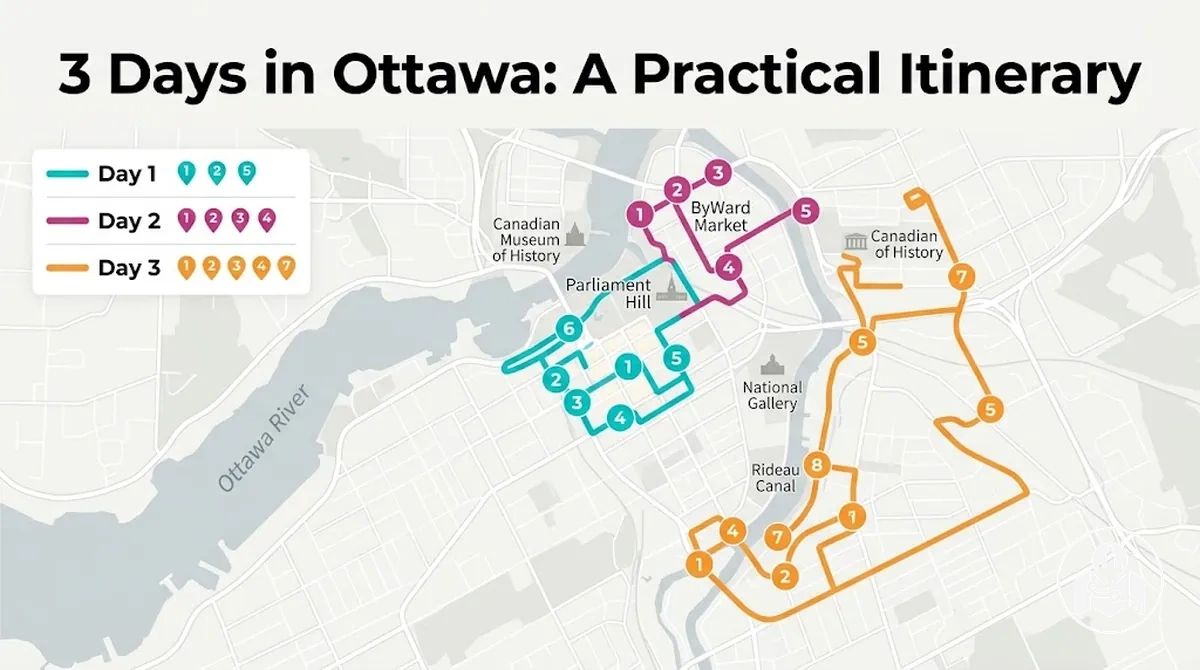
Three-day Ottawa plan at a glance
Use each day’s anchor as the fixed planning layer. Treat extra stops as flexible and keep the route selective enough to absorb changes in access, weather, travel time and energy.
-
Central Ottawa cluster
Parliament Hill → Rideau Canal → ByWard Market.
Flexible layer: add nearby central sights only after the three anchors still fit comfortably.
-
Culture + Ottawa River
Choose one major museum as the fixed time anchor, then add river sights that fit the remaining window.
Reduce first: longer transfers and any additional cross-river movement when the museum visit uses more of the day.
-
Flexible outdoor block
Choose one Ottawa-area outdoor stop only when travel, conditions, physical effort and the return journey remain manageable.
Protect: the return buffer; shorten or replace the outing if conditions or departure logistics tighten.
Adjustment rule: preserve the daily anchor, then shorten → move → remove optional stops as usable time or energy decreases.
This itinerary is intentionally selective rather than a checklist of every attraction. Check date-specific access and weather for activities that depend on current conditions, and use geographic clustering to limit unnecessary backtracking.
Table of Contents
How to Pace a First-Time Three-Day Visit to Ottawa
Pacing a three-day Ottawa visit should be based on usable sightseeing hours and realistic daily capacity, not on the three-day calendar label alone.
A day with a longer sightseeing window can support more walking, museum time and transfers, while a shortened day requires a smaller sightseeing load.
The illustration below represents this pacing principle across three day segments, showing how central sightseeing, museum time and a flexible outdoor block can occupy different parts of the trip without fixing exact times.

Three full sightseeing days provide more usable time than three calendar days that include a partial arrival or departure day.
When arrival or departure substantially reduces the sightseeing window, daily capacity should be reduced rather than shifting the same amount of activity into fewer usable hours.
If the available time no longer supports the intended pace, it is useful to work out how many days you need in Ottawa before treating three calendar days as three complete sightseeing days.
The itinerary is realistically paced when each day's planned load still fits after accounting for access conditions, walking, museum time, transfers and the visitor's energy level.
Day 1: Parliament Hill, Rideau Canal and ByWard Market
The Day 1 central route groups Parliament Hill, the Rideau Canal and ByWard Market into one central Ottawa sightseeing cluster.
Follow that sequence to keep the main stops spatially connected while leaving flexibility for security procedures, tours, meals and unplanned pauses.
Treat access and activity availability as conditions to check for the visitor's date rather than fixed parts of the schedule.
The three anchors support a walking-focused sequence through the downtown core, with nearby supporting sights added only when the main route remains comfortable.
This is the practical reason to combine Ottawa attractions by area: each additional stop should fit the central cluster instead of creating unnecessary backtracking.
The illustration below shows the geographic sequence without assigning unverified distances or walking times.

Use the three anchors as the fixed structure for Day 1, then make nearby additions conditional on access, usable time and energy.
The sequence moves from the Parliament area toward the Rideau Canal and then ByWard Market, so each stop has a clear handoff to the next rather than functioning as an isolated attraction.
- Start at Parliament Hill. Use Parliament Hill as the first major sightseeing anchor and check current access or tour conditions before relying on an interior visit or scheduled activity. If access is limited, keep the exterior Parliament area as the starting point and continue the central route rather than waiting for an unavailable activity.
- Continue toward the Rideau Canal. Use the canal area as the connecting sightseeing element between the Parliament area and the next part of central Ottawa. Walk the relevant central section when conditions suit the visit, but treat any specific canal activity as optional because availability can depend on the date and conditions.
- Finish the main sequence in ByWard Market. Use ByWard Market as the third anchor for its neighbourhood setting and food options after the earlier sightseeing stops. Keep time for exploring the immediate area, while treating other nearby attractions as optional additions rather than extending the route into a wider downtown inventory.
Optional nearby stops should come after Parliament Hill, the Rideau Canal and ByWard Market remain feasible within the day's available time.
Adding them earlier can weaken the central sequence by increasing walking, waiting or transfer effort before the three anchors are complete.
If Parliament-related access is unavailable, keep Parliament Hill as an exterior starting point and continue toward the Rideau Canal and ByWard Market; if a planned canal activity is unavailable instead, use the canal as a walking and sightseeing connection rather than making that activity essential.
This preserves the central Ottawa sequence while allowing Day 1 to adjust to actual access conditions.
Day 2: Build the Day Around a Major Museum and Ottawa River Sights
Make one major museum the fixed time anchor for Day 2, then add Ottawa River sights only when the museum block leaves enough usable time.
This keeps the Day 2 museum-and-river plan realistic: the cultural stop is the fixed commitment, while river views and other river-side sights remain flexible additions.

Choose the museum according to four criteria that determine how much of the day remains available.
The Canadian War Museum and National Gallery of Canada are in Ottawa; the Canadian Museum of History is in Gatineau, Quebec, across the Ottawa River. That location difference matters because choosing the Canadian Museum of History makes a cross-river transfer part of Day 2. Choose the museum by visitor interest, access, location and expected visit length rather than ranking the institutions.
- Visitor interest: choose the museum whose subject matter matches what the visitor wants to spend a substantial part of the day exploring.
- Access: check current opening and admission conditions for the intended date before treating the museum block as fixed.
- Location: consider where the museum sits relative to the intended Ottawa River sights, because a longer transfer leaves less time for additions.
- Expected visit length: allow museum time to reflect the intended depth of the visit; a longer dwell time means fewer river-side sights remain feasible.
Once the museum is chosen, build the rest of Day 2 around its location and the time remaining after the visit.
Ottawa River viewpoints or nearby river-oriented sights should fit around that fixed block rather than compete with it for time.
- Choose one major museum. Match the cultural stop to visitor interest, then verify current access for the intended date. Keep one museum as the day's fixed commitment instead of trying to include several major institutions.
- Anchor the museum block. Allow for expected dwell time and the museum's location before assigning other sightseeing. A longer museum visit or a location requiring more movement leaves less capacity for river-side sights.
- Add Ottawa River sights that fit the remaining time. Use nearby river views or river-oriented stops when they follow naturally from the museum location. Keep these additions conditional so the museum visit does not have to be shortened simply to complete a longer list.
- Defer longer or cross-river additions when necessary. Include a longer transfer or cross-river movement only when access, museum time and the remaining sightseeing window make it practical.
Cross-river movement is part of the route when the chosen museum is across the Ottawa River; otherwise it remains optional and should be added only when access, museum dwell time and the remaining sightseeing window make it practical.
When those constraints reduce the available sightseeing window, reduce the river-side additions rather than forcing another substantial transfer.
The major museum remains the fixed Day 2 commitment, while Ottawa River viewpoints and other river-side sights expand or contract according to the time left after that visit.
This keeps the sequence feasible without turning every museum or waterfront attraction into a mandatory stop.
Day 3: Add a Longer Outdoor Stop Beyond the Central Route
Use Day 3 as the flexible longer outdoor block, adding one Ottawa-area outdoor stop beyond the compact central route only when travel time, conditions, physical effort and the return buffer remain manageable.
The outdoor stop should provide a different setting from the central sightseeing days without turning the final day into a separate regional trip.

Structure the day as travel out, complete the main outdoor activity, then return with a buffer rather than filling the entire available window.
This sequence keeps travel time and activity duration within the same feasibility decision, so a longer journey or longer activity requires more of the day to remain uncommitted.
Judge suitability through four practical criteria before committing to the outdoor block.
Season and weather can change which activities are practical, so plan around Ottawa seasons while also checking site access for the intended date.
- Travel burden: the journey to and from the outdoor stop must leave enough usable time for the activity and the return buffer; greater travel time reduces the time available outdoors.
- Conditions and access: season, weather and current site access determine whether the intended activity is suitable on the day; conditions that restrict access or comfort require a shorter or different plan.
- Physical effort: walking demand and other activity requirements should fit the visitor's mobility and energy level; greater effort can justify a shorter route or less demanding activity.
- Return-time margin: keep part of the available window uncommitted for the return journey; if the outbound journey or activity takes more time than expected, reduce the outdoor block rather than eliminating the return buffer.
- Travel out. Choose one Ottawa-area outdoor stop whose travel burden fits the available day, and check current conditions and site access before relying on a specific activity.
- Complete the main outdoor activity. Keep the activity appropriate to the weather, season and visitor's physical effort level, and shorten it when those conditions reduce suitability.
- Protect the return buffer. Begin the return with enough margin for the planned journey back instead of adding another distant stop when the remaining time becomes limited.
An Ottawa Greenbelt site can serve as one example of this type of outdoor stop when its travel burden, current conditions and access fit the day’s route.
Because Greenbelt destinations are spread across different locations, the specific site and activity determine the travel demand; trail status, weather and other operational conditions should still be checked for the intended date.
If poor weather, limited mobility or unsuitable site access makes the longer outdoor block impractical, shorten the outing or replace it with a lower-effort Ottawa-area activity that requires less exposure and travel.
The Day 3 plan remains balanced when the adaptation preserves the return buffer rather than forcing the original outdoor stop under unsuitable conditions.
How to Adapt the Itinerary to Arrival, Departure and Daily Pace
The adaptation rule for the three-day Ottawa itinerary is to preserve each day's priority cluster first, then compress, move or remove secondary stops when usable time or energy decreases.
This adjustment order keeps the three-day macro-plan coherent without requiring a fixed cut-off for arrival time, departure time or daily sightseeing capacity.
Arrival time, departure time and attraction access change how much of a planned sequence is feasible.
A later arrival reduces usable time at the start of the trip, an earlier departure reduces it at the end, and restricted attraction access can require a stop to move within the relevant day or be deferred; in each case, protect the priority cluster before reducing secondary stops.
The annotated example below shows three day blocks with a core cluster for each day and optional stops that can be shortened, moved or removed without assigning exact hours.

Adjustment order
- Keep the priority cluster while it still fits the available time, access conditions and visitor’s pace.
- Shorten flexible activities when usable time or energy is tighter. Lower walking tolerance or more frequent breaks should reduce optional volume rather than force a faster pace.
- Move secondary stops only when another part of the three-day plan can accommodate them without weakening that day’s main focus.
- Remove secondary stops when time, access or pace no longer supports them comfortably.
What changes the plan: arrival time, departure time, attraction access, walking tolerance, break frequency and energy can change sequence or volume without automatically requiring a completely new itinerary.
If You Arrive Late on Day 1
A late arrival on Day 1 should reduce the central route rather than compress the entire sequence into the remaining evening window.
Keep one compact central cluster that fits the usable time, then shorten or defer secondary stops instead of treating the full Day 1 plan as mandatory.
The image below illustrates this shortened central Ottawa sightseeing context without implying exact evening hours or guaranteed attraction access.
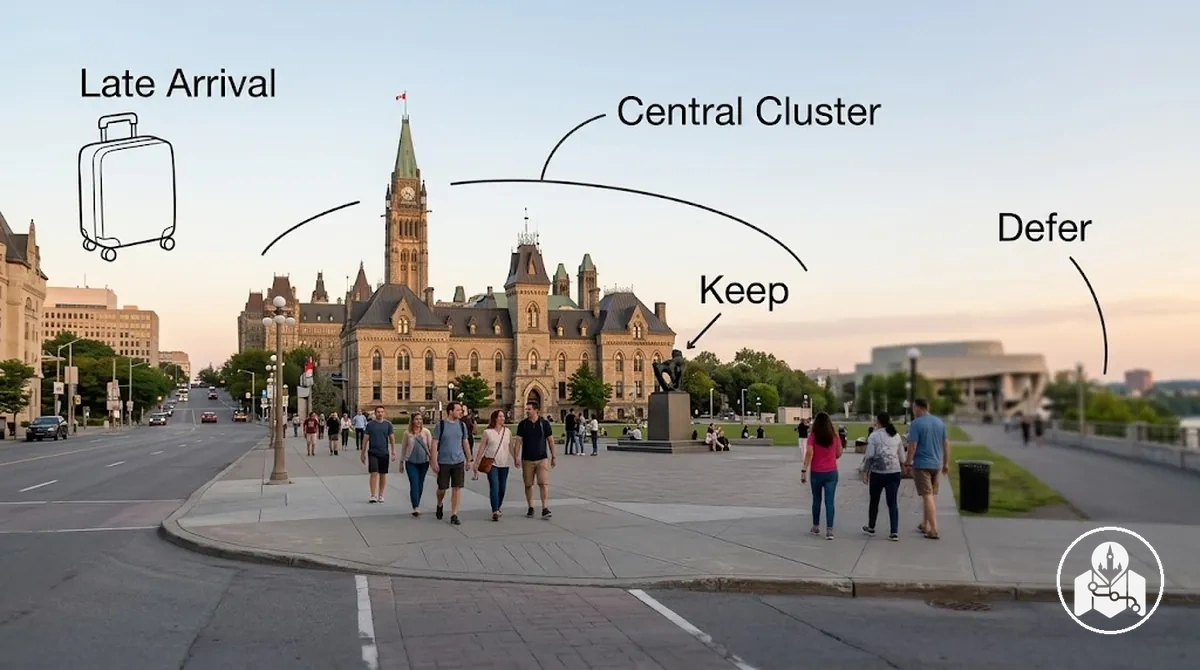
Remaining usable time depends on how much of the day is left after arrival and settling time, while attraction access and fatigue determine how much of that window is practical for sightseeing.
When access or energy limits the evening, keep the most feasible nearby stops within the central cluster and defer activities that would require a longer sequence or depend on unavailable access.
With several usable evening hours, a visitor can keep a compact part of the central cluster and shorten nearby secondary stops according to remaining time and fatigue.
If the late arrival occurs after most scheduled attractions are unavailable, keep only a feasible central sightseeing cluster that does not depend on that access and defer the remaining stops to another suitable part of the itinerary.
If You Leave Early on Day 3
An early departure on Day 3 usually makes the longer outdoor block the first part of the itinerary to shorten, relocate or remove when departure logistics materially limit usable sightseeing time.
If enough time remains after those requirements, replace the longer outing with a shorter nearby activity rather than compressing the original Day 3 plan into a tight departure window.
Departure-day decision
- First, calculate the usable window
- Start from the actual departure time, then allow for the transport buffer, luggage handling and transfer duration required by the specific journey. There is no universal airport or station buffer that fits every departure arrangement.
- If a meaningful sightseeing window remains
- Choose a short nearby activity that can be shortened or removed without compromising departure logistics.
- If the trip effectively has only two full sightseeing days
- Treat that as the planning boundary and see the two-day Ottawa itinerary rather than forcing a substantial Day 3 activity.
If You Prefer a Slower Three-Day Pace
A slower pace should reduce the stop count each day while preserving geographic clustering and one dominant daily focus.
Keep the main activity or central cluster for each day, then allow fewer secondary stops rather than spreading the same volume across a longer, more tiring schedule.
Slower pace: keep the structure, reduce the volume
Preserve
Geographic clustering and one dominant daily focus. The route remains coherent even when optional stops disappear.
Reduce first
Secondary stops and walking-heavy additions when mobility needs, walking tolerance or fatigue call for a lighter day.
Give more time to
Museum dwell time, meal breaks, rest and spontaneous exploration; extra time here means fewer optional stops elsewhere.
Example: keep the Day 1 central cluster, one major Day 2 museum and a simplified Day 3 outdoor experience, while allowing longer breaks and fewer secondary stops.