
Ottawa Rainy Day Itinerary With Indoor Attractions
An Ottawa rainy-day itinerary works best as an indoor-first, flexible route: start with one substantial indoor anchor, continue to a nearby indoor stop, and keep the final activity easy to shorten, replace or skip. Before each major transfer, verify same-day access and current rain conditions; if either changes, shorten the exposed segment, reorder stops or use a nearby indoor backup.
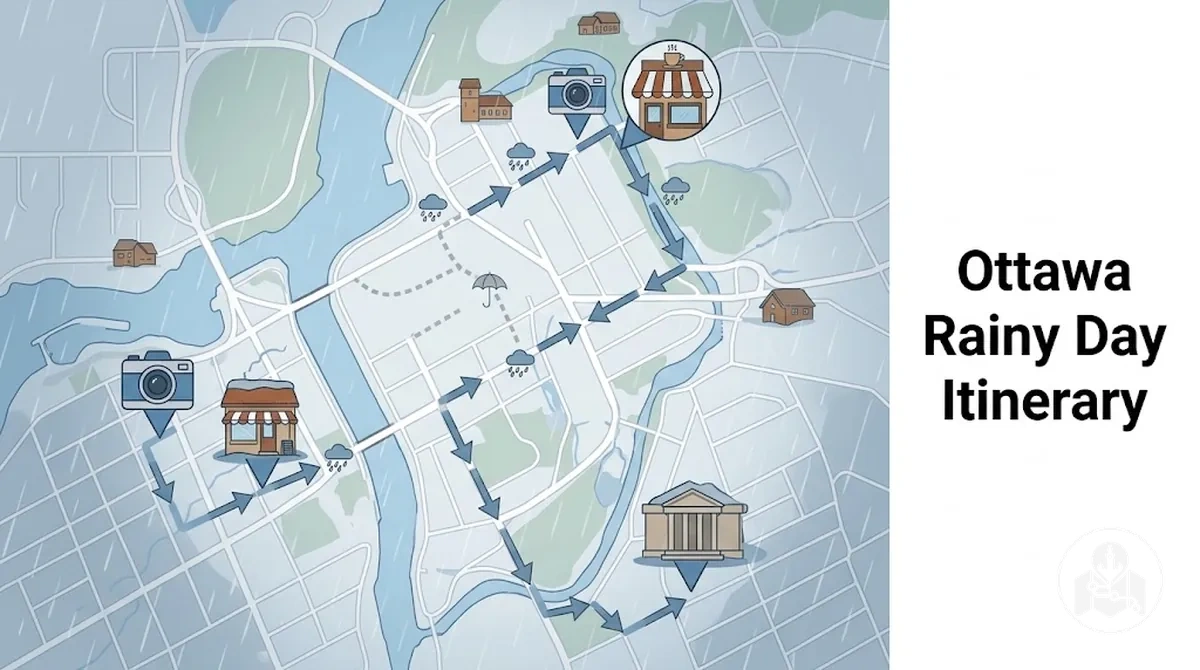
Rainy-day route planner
Build the day around one dependable indoor anchor, keep the next stop nearby, and preserve the afternoon as the most flexible block. Recheck access and rain before each major move.
- MorningAnchor indoorsChoose a museum or gallery with workable same-day access and enough visit time to carry a substantial part of the sightseeing day.
- MiddayContinue nearbyMove to a nearby indoor attraction only when the transfer, available time and admission conditions still fit the route.
- AfternoonKeep it flexibleUse an indoor activity that can be shortened, replaced or skipped if earlier visits run long or conditions change.
Treat clock times and sample venues as flexible. The usable route depends on current access, remaining time, weather, location, traveller pace and comfort.
Rain intensity and duration affect outdoor exposure, while opening windows, entry conditions, location and expected visit duration determine which indoor stops fit. Adjust only the affected segment whenever possible, so the rest of the day remains stable.
Table of Contents
Prepare an Indoor-First Route for a Rainy Day in Ottawa
An indoor-first Ottawa route starts with one substantial indoor anchor stop, then groups nearby substitutes and short transfers around it.
The route should also include a backup option and same-day verification so changes in attraction availability or rain conditions can be absorbed before they disrupt the sequence.
- Access and opening window
- Fixed constraints. Verify same-day access, opening information and any applicable entry window before fixing the route order.
- Transfer exposure
- Shorter is usually more practical in rain. Favour geographically close alternatives when exposed movement becomes less workable.
- Backup capacity
- Keep at least one workable substitute. A nearby indoor backup can absorb a closure, delay or access change without breaking the whole sequence.
Use the sequence below to organise anchor selection, proximity, access constraints, backup capacity and final verification before departure.
The diagram shows how an anchor stop, nearby indoor alternatives, short exposed transfers and a backup path work together without prescribing exact distances or current operating times.
- Choose the anchor stop. Select one indoor attraction that can occupy a meaningful part of the sightseeing period, subject to its current access conditions and expected visit duration.
- Group nearby indoor alternatives. Add substitute stops close enough to limit unnecessary transfer exposure and reduce the effect of a disrupted segment.
- Separate fixed constraints from flexible choices. Treat opening or access windows as constraints to verify, while route order and backup selection remain adjustable when conditions change.
- Assign a backup option. Give the anchor stop or an exposed segment at least one substitute that can take its place if access changes, a delay develops, or heavier rain makes the original transfer less practical.
- Verify same-day conditions. Recheck attraction access, opening information, timed-entry requirements where applicable, and weather conditions before leaving, then adjust the route order if needed.

If the planned anchor stop becomes unavailable before departure, a nearby substitute can take over that block while the remaining indoor route stays largely intact.
A defined backup rule reduces the chance that one access change will break the route entirely and provides a natural point to build contingency plans into your itinerary; the priority is to choose anchor stops with workable access, useful indoor duration, and practical nearby alternatives.
Use Museums and Galleries as Anchor Stops
Museums and galleries can work as anchor stops when they provide substantial indoor duration and fit the rainy-day route geographically and operationally.
A practical anchor attraction combines useful visit duration with an opening window, access requirements, and location that fit the rest of the day.
Access and indoor duration should be assessed first because an attraction that is unavailable or too brief for the planned schedule cannot perform the intended anchor role.
The opening window must fit the route timing, while audience fit determines whether the indoor visit suits the travellers using the itinerary.
Proximity to the onward stop also matters: a closer next stop limits transfer exposure, whereas a distant location can increase time spent outside in the rain.
The National Gallery of Canada, Canadian War Museum and Canadian Museum of Nature are examples of cultural attractions to test against these criteria; whether one works as the anchor depends on that day’s access, route position and traveller interests.
- Anchor-worthy — access requirements: confirm same-day access and any applicable admission or timed-entry conditions; uncertain or incompatible access reduces the attraction’s usefulness as an anchor stop.
- Anchor-worthy — indoor duration: favour a visit duration substantial enough to occupy a meaningful part of the planned sightseeing period and reduce repeated outdoor exposure.
- Anchor-worthy — opening window: the available visiting period should fit the intended route position; awkward timing can require a different stop order or another anchor.
- Route cost — proximity: consider the distance to the next planned indoor stop; greater separation increases transfer exposure when rain makes outdoor movement less practical.
- Route cost — audience fit: choose a museum or gallery whose subject matter and visiting format suit the travellers involved rather than assuming one cultural attraction suits every audience.
- Route cost — schedule fit: weigh substantial indoor time and workable access against long transfers or timing constraints; use the attraction as an anchor only when its indoor value fits the wider rainy-day route.
The image below illustrates the type of sheltered cultural setting that can absorb a meaningful part of a rainy sightseeing day while keeping the focus on the anchor-stop function rather than a particular venue.

Add Flexible Indoor Activities Around the Main Stops
Flexible indoor activities can absorb a schedule gap or replace a disrupted outdoor segment without becoming mandatory anchor stops.
Their value comes from low-disruption substitution: a flexible stop fits around the main route when timing or conditions change rather than adding another fixed commitment.
Timing determines whether an indoor alternative can fit the available gap, while booking dependence affects whether it can function as a practical backup stop at short notice.
Duration should fit the available schedule window instead of forcing changes to the main stops, and location should keep the substitute practical relative to the existing route.
Substitution is easier when the activity can be added, shortened, skipped, or exchanged for another indoor option without destabilizing the rest of the itinerary.
The scheduling functions below show how route flexibility can respond to different disruptions without turning each flexible indoor activity into a required stop.
- Fill a schedule gap: use a flexible indoor activity when an earlier stop finishes sooner than expected and time becomes available before the next fixed part of the route.
- Extend indoor time: add an indoor alternative when rain makes an exposed interval less practical and the activity fits the available timing and location.
- Replace an outdoor segment: substitute an indoor stop when worsening rain makes the planned outdoor portion less suitable while leaving the surrounding route workable.
- Absorb a delay: use a nearby flexible stop when a timing change creates a wait, provided its booking dependence and duration allow it to fit without disrupting the next main stop.
If a main stop ends early and creates a schedule gap, a nearby flexible indoor activity can fill that interval when its access and timing are workable.
The image below shows how that flexible stop can absorb the schedule change as a backup rather than becoming another mandatory anchor.

If the substitute cannot fit the available window, skipping it preserves the main route.
That is the practical distinction between a flexible backup activity and a fixed anchor stop.
Keep Outdoor Transfers Short and Check Same-Day Access
Transfer and access checks improve route reliability when each outdoor transfer is kept as short as practical and same-day access is verified before committing to the next major stop.
The check should cover both rain exposure during the move and whether the destination can be entered under its current operating conditions.
Movement risk comes from transfer distance and outdoor rain exposure, so shorten an exposed transfer, reorder stops, or allow a time buffer when the planned movement becomes impractical.
Access risk comes from changeable conditions such as opening hours, timed entry, or a temporary closure; verify current official attraction information immediately before travel, then reorder the route or activate a backup stop when the planned entry condition cannot be met.
The annotated example shows how exposure and access checks work together for one route segment without becoming a full transport map.
Use the verification list to check the next segment and apply the stated route adjustment when a condition fails.

- Transfer distance: check whether the next outdoor transfer keeps exposed movement practical for the current rain conditions; if not, choose a closer stop or reorder the route.
- Rain exposure: check whether the expected outdoor exposure remains workable as conditions change; if not, shorten the exposed segment or substitute an indoor alternative.
- Opening hours: verify the destination's current same-day opening information; if the available opening window no longer fits the route, change the stop order or use a backup stop.
- Timed entry: verify whether entry is tied to a particular time or other current entry condition; if the route cannot meet that condition, allow a time buffer, reorder the stop, or use an alternative.
- Temporary closure: check current official attraction information for a temporary closure or access restriction; if entry is unavailable, activate a backup stop rather than completing an unnecessary exposed transfer.
- Same-day access: verify any other current entry condition that could affect access immediately before travel; if the planned visit is no longer workable, adjust the route before starting the transfer.
Follow a One-Day Indoor Sightseeing Route Through Ottawa
A one-day indoor sightseeing route should begin with a substantial morning anchor, continue to a nearby midday stop, and finish with a flexible afternoon activity.
This sequence keeps indoor sightseeing central while allowing the one-day route to adapt when access conditions, weather, or individual pace affect execution.
Visit duration determines how much of the day the morning anchor can occupy, while location and transfer burden affect whether the midday stop remains practical without unnecessary exposed movement.
Access conditions should be checked before committing to the next stage because they can change the usable sequence.
The afternoon activity should retain more flexibility so remaining time, weather changes, or a disrupted earlier stop can be absorbed without forcing the rest of the route into a fixed schedule.
Keep timing approximate rather than forcing universal clock times or visit lengths. Let actual access, visit pace and the remaining day determine each transition.
The visual and three-stage summary organize the morning-to-midday-to-afternoon sequence by indoor duration, proximity, and flexibility rather than fixed clock times.

- Morning: begin with a substantial morning anchor that can support a meaningful indoor visit, subject to workable access conditions and visit duration.
- Midday: continue to a nearby midday stop that limits transfer burden and fits the remaining sequence after the morning visit.
- Afternoon: finish with a flexible afternoon activity that can fit the remaining time or be adjusted when weather, access, or earlier delays change the plan.
This rainy-day sequence adapts the broader sightseeing context rather than replacing it; use it to adapt a one-day Ottawa plan when indoor emphasis and weather flexibility are needed.
Morning: Begin at a Major Museum or Gallery
The morning anchor should be a museum or gallery that provides a substantial indoor visit and a stable first indoor stop for the rainy-day route.
Select it so its opening time, expected visit duration, and entry conditions fit the morning stage rather than assuming a fixed start or universal visit length.
The image represents the type of substantial first indoor stop used to stabilise the rainy-day route without recommending a particular venue.

- Before entry
- Verify the opening time and entry conditions before beginning the visit.
- Visit length
- Use a duration that fits current access and traveller pace rather than forcing a fixed visit length.
- Onward position
- Favour a location that leaves a practical nearby indoor stop; when the visit ends, continue only if that next stop’s access and location remain workable.
Midday: Continue With a Nearby Indoor Attraction
The midday stop should usually be a nearby indoor attraction whose proximity and available time fit the morning endpoint.
Keeping the second indoor stop nearby limits transfer distance and helps the route remain practical when rain conditions or the length of the morning visit change the remaining schedule.
Continue when
The transfer remains practical in the current rain, lunch timing leaves enough room for the expected visit, and admission is available in the intended midday window.
Switch when
Access changes, the transfer becomes impractical or too little time remains. Choose a nearer indoor alternative that fits the available window instead of forcing the original stop.
Afternoon: Finish With a Flexible Indoor Activity
The afternoon activity should preserve flexibility because earlier visits may run long and the remaining time can vary.
Choose a final indoor stop that can remain practical without requiring a rigid arrival time or a substantial detour.
Adjust the Rainy-Day Route as Weather Conditions Change
Adjust the rainy-day route only where current weather conditions, access or transfer practicality make the planned sequence less workable.
Rain intensity, rain duration, outdoor exposure, transfer length, and attraction access should determine which part of the route changes while unaffected indoor sightseeing stops remain in place.
Lighter or intermittent rain may allow a short outdoor transfer to remain practical when walking conditions, access, and the next stop still fit the route.
Heavier or persistent rain may justify shortening outdoor exposure, changing stop order, or using an indoor substitute when a longer transfer becomes less practical.
Because conditions can change during the day, base each adjustment on observed rain and current access information rather than assuming that a forecast will produce a particular dry or wet interval.
The conditional sequence below links the observed weather condition to the smallest practical route adjustment.
- Dry or light break: continue with the planned stop order when the next transfer remains practical, access is available, and the outdoor segment does not create unnecessary exposure.
- Intermittent rain: shorten the exposed transfer or change stop order when doing so reduces rain exposure while preserving nearby indoor stops that still fit current access conditions.
- Persistent or heavier rain: reduce exposed movement and use an indoor substitute when transfer length or walking conditions make the planned outdoor segment impractical.
Prioritize the smallest useful adjustment: shorten outdoor exposure first, then reorder stops, and activate a backup indoor stop when the affected segment cannot remain practical.
Rain-specific route adaptation is separate from colder-season planning; travellers dealing with snow, ice, or winter conditions should instead plan for winter weather.
Use Dry Breaks for Short Outdoor Sightseeing
A genuine dry break can justify a short outdoor segment only when it is nearby, optional, and easy to abandon if rain returns.
The outdoor segment should remain a temporary addition to the indoor-first route rather than becoming a new walking itinerary.
Use a short outdoor break when
Precipitation is currently absent, the walk is brief, available time is sufficient and the next indoor stop is close enough that returning indoors is straightforward if conditions change.
Stay indoors when
Precipitation is uncertain, the walking distance creates unnecessary exposure or the next indoor stop is too far away to make the segment easily reversible.
Example: a brief nearby walk can fit between indoor stops during a genuine dry break; if rain resumes, end the outdoor segment and continue directly to the planned indoor fallback.
Keep the Route Predominantly Indoors During Persistent Rain
Persistent rain shifts the route toward longer indoor visits and fewer exposed transfers while still allowing necessary movement between stops.
A predominantly indoor route should reduce avoidable rain exposure without assuming that every outdoor segment must be eliminated.
- Extend the current indoor visit when attraction availability and remaining time make that practical.
- Replace an exposed transfer when continued rain, traveller comfort or route conditions make that segment less practical.
- Use the nearest workable indoor alternative when proximity and current access make substitution easier, keeping the route indoors as much as practical without treating an ordinary rainy day as a severe-weather plan.