
Ottawa Winter Itinerary for a Short Trip
Plan a short Ottawa winter sightseeing day around each stop’s dependency on daylight, current conditions, operating status, and transfer time rather than a fixed clock. Put the most daylight- or condition-sensitive outdoor stops earlier, alternate exposed periods with nearby sheltered stops, and keep indoor or evening-suitable activities for later; if conditions change, reorder, replace, or remove a stop instead of compressing the remaining schedule.

Plan by dependency, not by a rigid timetable
Ottawa winter day planner
Use four conditions to decide where a stop belongs: daylight need, winter exposure, operating status, and transfer burden.
-
Verify the stopCheck current weather and surface conditions, the activity’s operating status, and whether its access still works for the intended visit period.
-
Protect scarce conditionsGive earlier priority to stops that depend strongly on natural light, suitable snow or ice, a limited operating window, or conditions that may be harder to reproduce later.
-
Use flexible stops as buffersPlace nearby indoor or low-light-suitable activities between more exposed stops when their hours, duration, and location fit the route.
-
Adapt without rushingWhen a stop becomes impractical, reorder it if still feasible, replace it with a suitable alternative, or remove it when keeping it would disrupt higher-priority plans.
Core decision rule: the harder a stop is to move later without losing its purpose, the earlier it should be protected in the day.
Cold, snow or ice can slow walking and transfers, while shorter daylight can make some outdoor stops more time-sensitive, so leave enough flexibility for the actual conditions on the travel date.
Table of Contents
How Winter Conditions Change Sightseeing in Ottawa
Winter conditions can change Ottawa sightseeing mainly through shorter daylight, cold exposure, snow or ice on walking surfaces, and less predictable transfer time between sightseeing areas.
These conditions can affect stop order, time outdoors, walking pace, buffer time, and the operating status of weather-dependent activities.
The practical result is a sightseeing schedule that may need more flexibility when the actual conditions differ from those assumed during planning.
These factors can interact rather than affecting the day separately: limited daylight can make an outdoor stop more time-sensitive while temperature and surface conditions can also influence how quickly that stop is reached or completed.
The image illustrates how daylight, winter surfaces, and outdoor exposure combine within an Ottawa sightseeing environment.
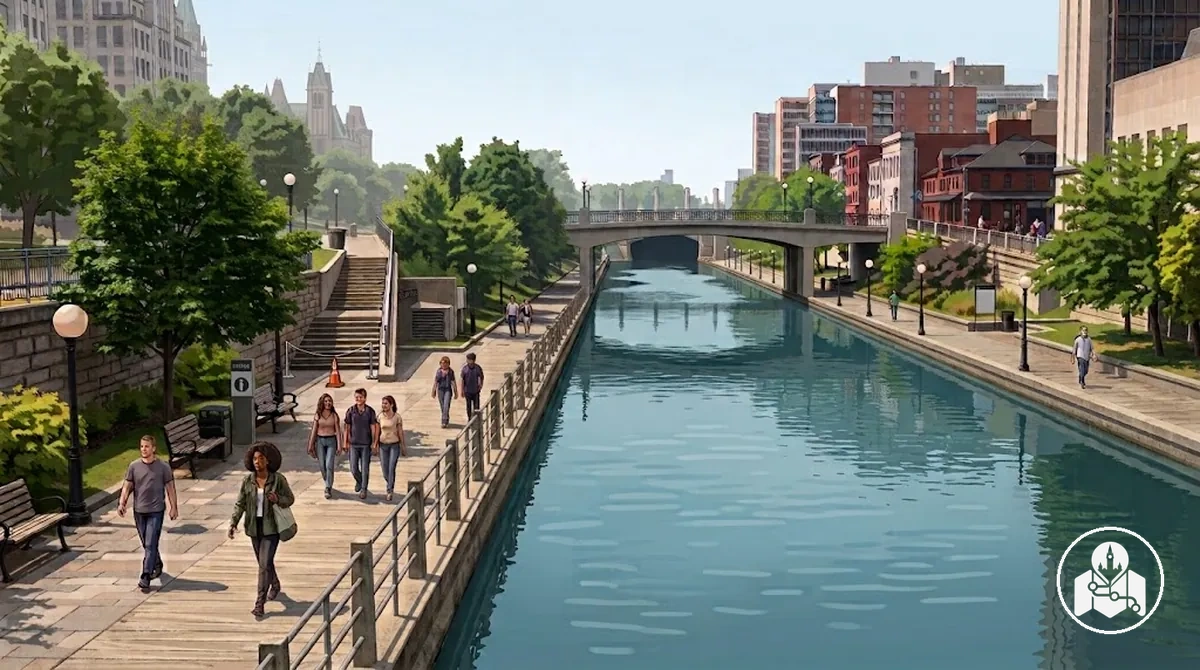
The table maps each main winter condition to a possible state, its sightseeing implication, and the corresponding planning response.
The exact effect depends on the travel date and actual conditions, so the entries describe conditional planning relationships rather than fixed winter values.
| Winter condition | Possible state | Sightseeing implication | Planning response |
|---|---|---|---|
| Daylight | Available natural-light time is shorter in winter and changes by date | Daylight-dependent outdoor sightseeing becomes more time-sensitive | Give those stops earlier priority while leaving indoor or low-light-tolerant activities for later |
| Temperature and exposure | Cold conditions can increase outdoor exposure, with the effect depending on weather and traveller tolerance | Long outdoor periods may require a slower pace or warm-up time | Alternate outdoor stops with suitable indoor periods when conditions make that useful |
| Snow or ice | Walking surfaces may be snowy, icy, slushy, or cleared depending on recent conditions | Walking pace and the time needed between nearby stops can change | Preserve schedule slack when surface conditions reduce normal walking pace |
| Transfer conditions | Walking, road, waiting, or transit conditions may make movement between areas less predictable | Transfer time can increase and tightly timed sequences can become harder to maintain | Use buffer time and avoid relying on an exact transfer duration when conditions are uncertain |
Ordinary winter constraints usually call for timing adjustments, such as reordering stops, shortening outdoor exposure, or preserving extra transfer time.
Conditions that materially disrupt the planned sequence, or a change in the operating status of a weather-dependent stop, may instead justify replacing or removing that stop.
This section concerns winter effects on sightseeing feasibility and timing rather than season selection; travellers making that broader decision can compare Ottawa seasons for a short trip.
For the winter itinerary itself, current daylight, surface, exposure, and travel conditions determine whether the schedule needs a minor timing adjustment or a larger change in sequence.
Limited Daylight Changes the Timing of Outdoor Stops
Limited winter daylight makes daylight-dependent outdoor stops in Ottawa more time-sensitive, but it does not make every outdoor activity unsuitable after dark.
Stops that rely on natural light for views, outdoor details, or the surrounding setting usually have greater scheduling pressure than activities that remain suitable in the evening.
The available daylight window varies by date, so stop order and duration should respond to the conditions for the actual travel day rather than fixed winter daylight hours.
As natural light becomes more limited, a daylight-dependent stop may need earlier placement or a shorter duration, while an evening-suitable activity can occupy a later period.
The image compares how an Ottawa outdoor sightseeing environment changes as natural light decreases.
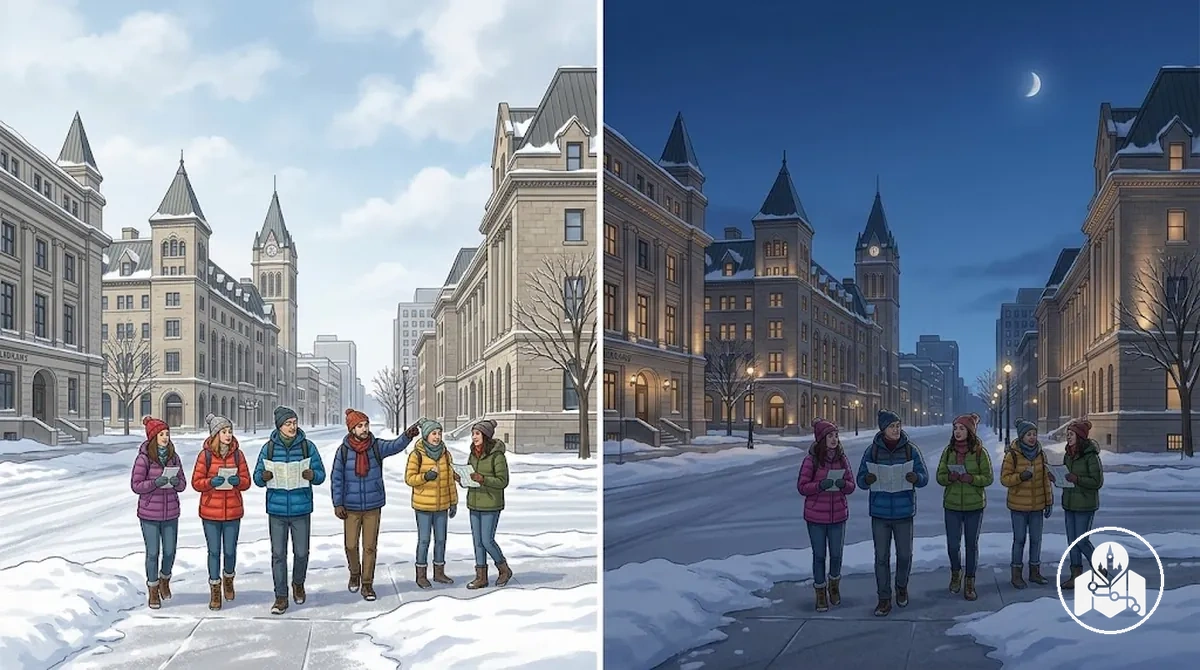
The main scheduling implications can be ordered from the strongest daylight pressure to activities with greater flexibility after dark:
- Daylight-dependent outdoor stop: when natural light is important to the experience, place the stop earlier in the sightseeing sequence.
- Longer daylight-dependent visit: when a stop needs both natural light and more time on site, allow enough of the available daylight window for its intended duration.
- Flexible outdoor stop: when reduced natural light does not materially affect the purpose of the visit, the stop can carry less pressure in the daytime schedule.
- Evening-suitable activity: when the experience remains suitable after dark, it can be positioned later without using daylight needed for more daylight-dependent sightseeing.
For example, an outdoor stop chosen for views or visible architectural detail is daylight-dependent and is more useful earlier, whereas an illuminated outdoor setting or suitable indoor option can fit into the evening.
The key distinction is not outdoors versus indoors; it is whether natural light materially affects the purpose of the stop.
Cold and Snow Reduce the Pace of a Sightseeing Day
Cold, snow, and ice can reduce the practical pace of winter sightseeing in Ottawa when winter exposure or surface conditions make movement less straightforward.
The image illustrates how snowy surface conditions and winter exposure can reduce walking pace in an Ottawa sightseeing environment.
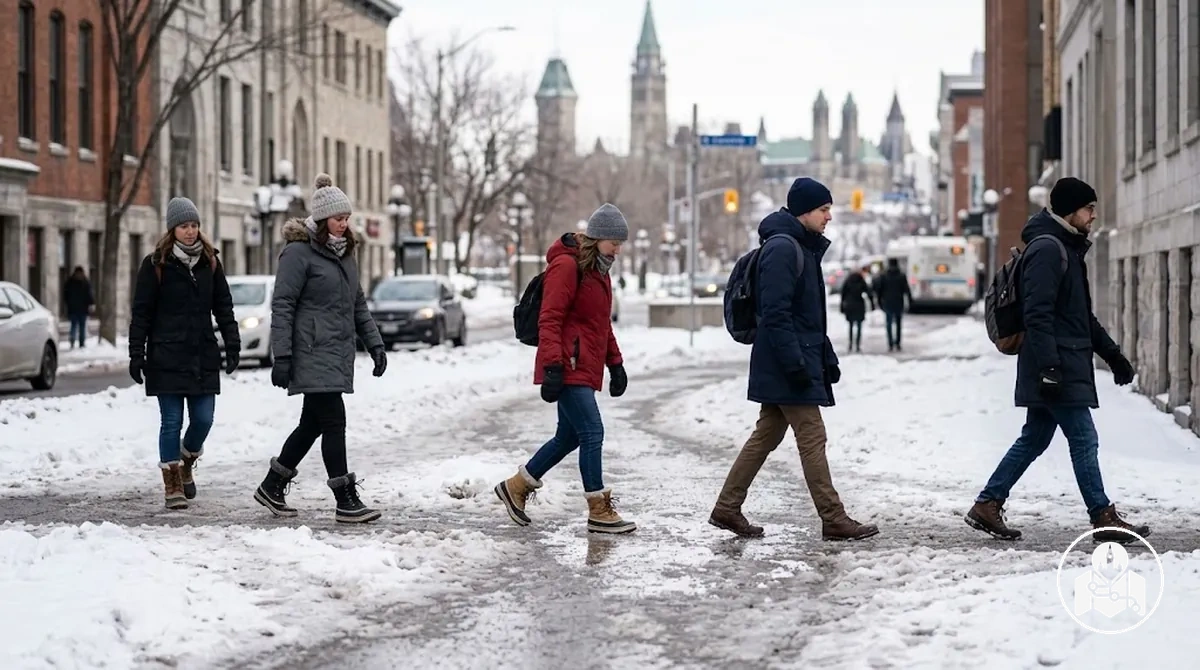
Walking surfaces
Snow, slush, or icy patches can encourage more cautious movement, so even nearby attractions may take more elapsed time to connect.
Cold exposure
Longer periods outdoors may make warm-up pauses useful; the effect depends on the actual weather and the traveller’s tolerance.
Indoor–outdoor transitions
Putting on or adjusting winter clothing between sheltered and exposed stops can add time to a transition.
There is no universal winter time penalty. Leave schedule slack according to the actual surface conditions, cold exposure, and traveller tolerance instead of assigning the same extra minutes to every transfer.
For example, two attractions that are geographically close may still require more elapsed time when snow or ice encourages cautious walking or when a warm-up pause is useful, so a tightly timed transition can make the remaining schedule harder to maintain.
Winter Travel Conditions Add Time Between Sightseeing Areas
Winter travel conditions can make transfer time between Ottawa sightseeing areas less predictable because walking conditions, waiting outdoors, road conditions, and transit variability can affect movement between stops.
Distance also matters: the farther apart sightseeing areas are, the greater the transfer burden can become when winter conditions affect part of the journey.
Buffer time should therefore be considered before fixing attraction times rather than assuming nominal distance will translate into a consistent transfer.
The image illustrates how distance between sightseeing areas and winter conditions can combine to increase the transfer burden between stop clusters.
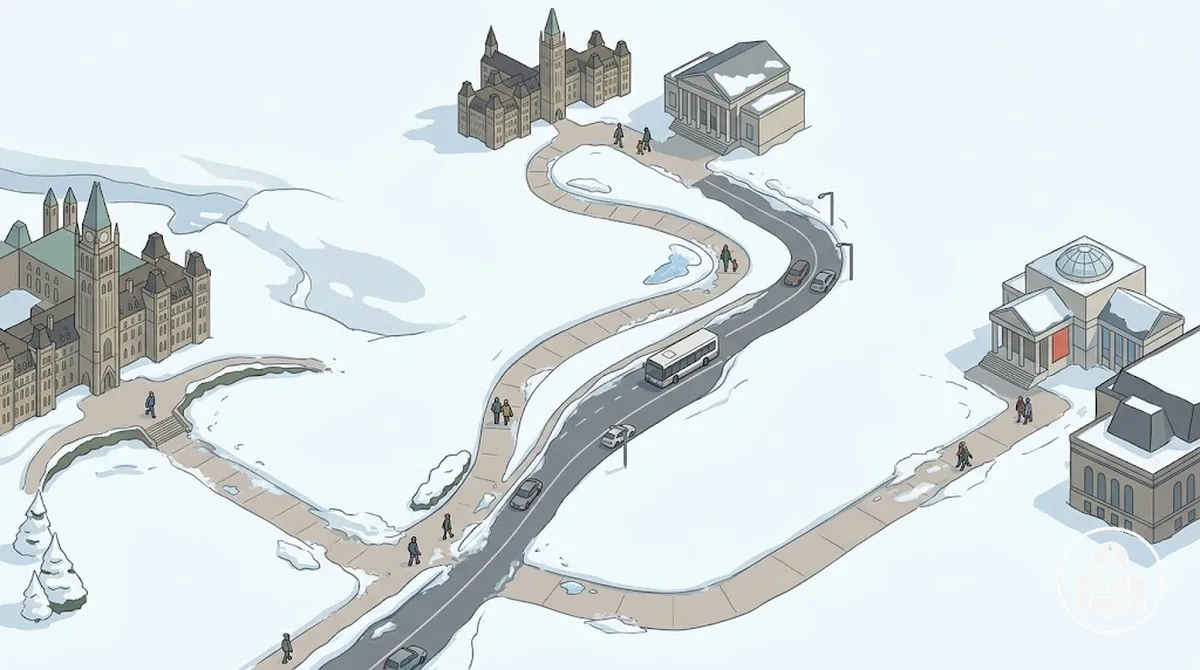
The following criteria organize the main sources of winter transfer-time variability and the planning consequence of each:
- Walking conditions: snow, ice, slush, or changing surface conditions can reduce walking pace, so transfers that include outdoor walking may need more buffer time.
- Waiting outdoors: a transfer that includes an outdoor wait can add uncertainty to the interval between stops, particularly when the next stage of the journey depends on that wait or connection.
- Transit variability: when service or connections do not align exactly with the planned stop sequence, transit can make transfer time less predictable, so tightly fixed attraction times leave less room for variation.
- Road conditions: snow, ice, traffic, or other winter road conditions can affect road-based travel time, so a planned transfer should not rely on an exact duration when conditions are uncertain.
- Distance between sightseeing areas: nearby stop clusters generally involve less area-to-area movement, while cross-city transfers expose more of the schedule to walking, waiting, road, or transit variability; keeping consecutive stops geographically coherent can reduce unnecessary backtracking.
For example, moving between two nearby stop clusters can involve a smaller transfer burden than crossing the city between widely separated clusters because less distance and fewer stages of movement are involved.
Detailed mode choice is a separate planning question; travellers who need to compare those options can plan winter transport in Ottawa.
For this itinerary, the key planning step is to account for distance and winter travel uncertainty with buffer time before fixing attraction times.
Choose Outdoor and Indoor Stops for a Short Winter Itinerary
A workable short Ottawa winter itinerary mixes weather-sensitive outdoor activities with indoor attractions that provide more shelter and timing flexibility.
The balance depends on weather exposure, daylight needs, operating status, and whether an indoor stop can provide a warm-up period between outdoor stops.
Neither type needs to dominate the day; each has a different planning role when conditions and available time are considered.
The image contrasts the planning role of weather-exposed outdoor stops with sheltered indoor stops within the same short itinerary.
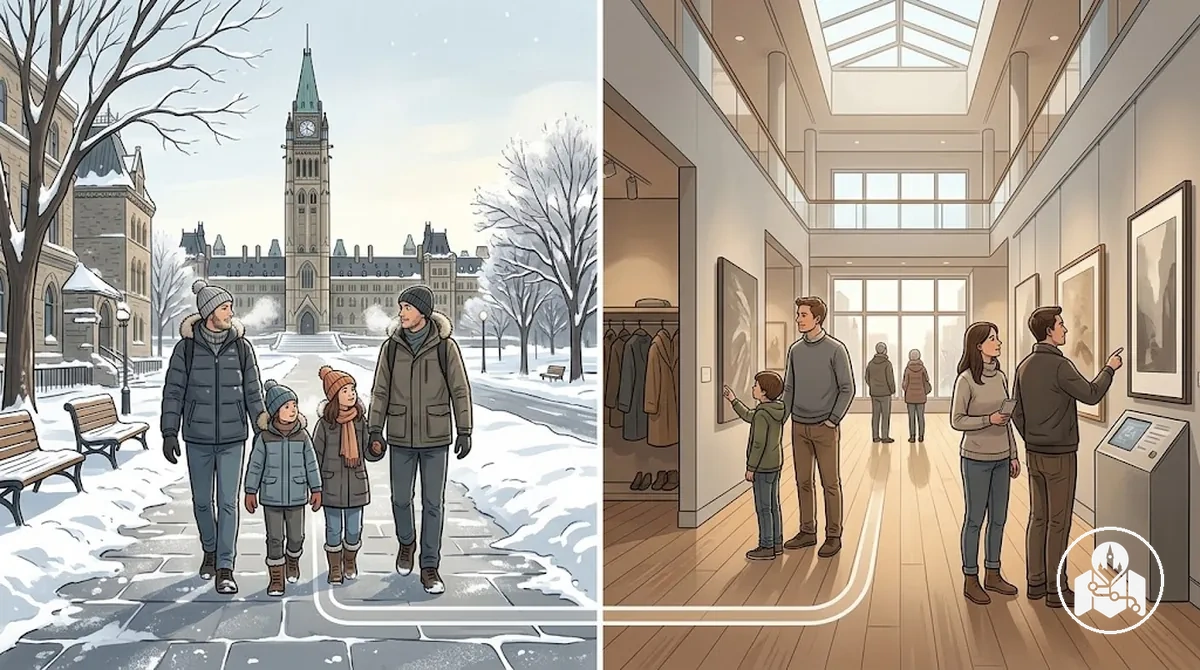
The comparison uses weather exposure, daylight dependence, operating status, duration, location, and rescheduling flexibility to show where each stop type can fit within the day.
These criteria distinguish activities whose timing is more condition-sensitive from sheltered activities that may be easier to reposition when their opening conditions allow.
| Stop type | Weather exposure | Daylight dependence | Timing flexibility | Best planning role |
|---|---|---|---|---|
| Outdoor/weather-dependent | Direct exposure to current winter conditions | Higher when natural light is important to the activity or setting | More condition-sensitive when weather or operating status affects availability | Place within the part of the day that suits the required daylight and confirmed operating conditions |
| Indoor/sheltered | Sheltered for most or all of the visit | Usually less dependent on natural daylight for the main experience | Potentially easier to reposition within confirmed opening hours and the intended visit duration | Use as a sheltered cultural or museum-type stop and, when useful, a warm-up period between outdoor activities |
Representative outdoor stops can include skating, snow activities, or winter events when their operating status and conditions are suitable on the travel date, while museums, galleries, and other indoor cultural stops can provide a functional contrast.
Seasonal availability, opening conditions, and venue hours should be checked for the specific date rather than assumed.
The aim is to balance weather-exposed and sheltered stops so the Ottawa winter itinerary remains workable without ranking either activity type as preferable.
Prioritize Weather-Dependent Outdoor Activities During Daylight
Give stronger daytime priority to outdoor activities when their usefulness or availability depends on daylight, weather, snow or ice conditions, cold exposure, or a limited operating window.
The more difficult a weather-dependent stop would be to reschedule after those conditions change, the earlier it belongs in the planning sequence.
The image illustrates why an outdoor winter activity can have greater daytime priority when both daylight and seasonal conditions affect whether it is practical.
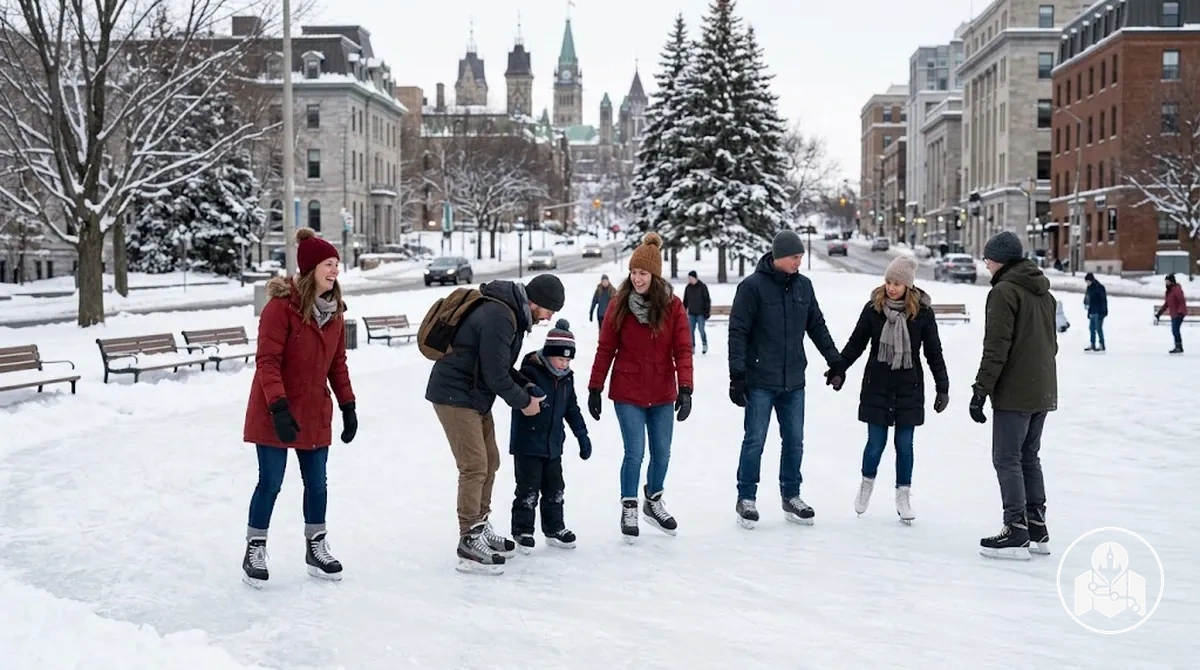
Use the following criteria to judge how difficult each outdoor stop would be to move later in the day.
Each criterion adds a different reason for increasing or reducing its scheduling priority:
- Daylight need: give stronger priority to an activity when natural light is important to the intended experience; an outdoor stop that remains suitable after dark can retain more timing flexibility.
- Snow or ice dependence: increase priority when the activity requires suitable snow or ice conditions, because changing conditions can affect whether the planned activity remains feasible.
- Operating status: treat a seasonal activity with a condition-dependent or limited operating window as less flexible, and verify its operating status for the intended date before fixing the sequence.
- Temperature exposure: consider how long the activity keeps travellers outdoors and whether actual conditions make that exposure practical; greater exposure can reduce flexibility even when the activity itself remains available.
- Ease of rescheduling: give lower priority to an outdoor stop that can be moved to another suitable period without losing its purpose, and stronger priority when few practical alternatives remain later.
For example, outdoor skating or winter festival programming can receive earlier priority when it is operating and its usefulness depends on suitable conditions or daylight.
Availability should be confirmed rather than assumed, because seasonal programming, ice readiness, and other operating conditions can change.
The priority rule is dependency strength: the more an outdoor stop depends on conditions that are difficult to reproduce later, the stronger its claim on the available daytime window.
Use Indoor Attractions for Warm-Up and Low-Daylight Periods
Indoor attractions can provide shelter and a warm-up interval between outdoor stops while also using low-daylight periods that are less suitable for daylight-dependent sightseeing.
Within a winter itinerary, their scheduling value comes from fitting a sheltered activity into the sequence without assuming that every indoor venue can fill any available gap.
- Opening hours
- The venue must be open during the intended period; verify the actual hours or operating status for the travel date.
- Visit duration
- The realistic visit length should fit the available gap without compressing the next activity.
- Location
- A nearby museum, gallery, or other sheltered stop can reduce unnecessary transfer time; a distant venue can disrupt the sequence despite providing shelter.
For example, a museum or gallery with suitable opening hours and a location near the day’s outdoor stops can occupy a low-daylight period or provide a sheltered interval after prolonged outdoor exposure. Use it as a buffer only when its shelter, location, visit duration, and verified availability improve the surrounding sequence.
Sequence Each Winter Sightseeing Day From Morning to Evening
Sequence a winter sightseeing day by placing the most condition-sensitive activities where their requirements are easiest to satisfy, while keeping more flexible activities available for later.
Morning, midday, and after dark should therefore be treated as parts of a dependency-based sequence rather than fixed clock blocks.
The order can change when daylight, exposure, operating windows, transfer time, or traveller pace changes.
Daylight dependence, weather exposure, operating windows, transfer time, and the ease of replacing a stop determine where an activity fits in the sequence.
A stop with narrow conditions has less freedom to move, while flexible activities can absorb changes elsewhere in the day.
The following principles apply that dependency logic without imposing clock times:
- Prioritize condition-sensitive stops: place activities with stronger daylight, weather, or operating-window dependencies where those requirements are most likely to be satisfied; move them when the relevant condition changes.
- Alternate exposure with flexible stops: use indoor or otherwise flexible activities between more exposed stops when this helps manage winter exposure or transfer time; adjust the order when proximity or operating windows make another sequence more practical.
- Move low-light-suitable activities later: keep indoor, illuminated, or other flexible activities for after dark when they do not depend strongly on natural light; move them earlier if their own operating window or location makes that more practical.
For example, the same set of stops could place a daylight-dependent outdoor activity first when conditions are favourable, followed by a nearby flexible indoor stop and then an evening-suitable activity.
If weather or operating conditions change, the flexible indoor stop can move earlier while the outdoor stop is delayed, shortened, or substituted without rebuilding the whole day around fixed times.
The same sequencing principle can be applied across a longer stay: travellers can adapt a three-day Ottawa itinerary by using the daily dependency logic without turning each day into a fixed timetable.
Morning: Start With Weather-Sensitive Outdoor Stops
Use the morning for a high-priority outdoor stop when daylight, current conditions, surface conditions, or a limited operating window make that stop harder to move later.
Morning is useful in this role only when the activity's requirements and operating status support early placement.
- Check conditions: review current weather and surface conditions, then confirm the stop’s operating status for the intended visit period.
- Choose by dependency: give morning priority to the outdoor stop with the strongest daylight or condition dependency rather than selecting by popularity alone.
- Protect the next transfer: leave enough travel time for a slower-than-expected transition so the rest of the sequence is not compressed.
- Verify again close to the visit: do not assume the first plan remains practical if conditions or operating status change.
Midday: Alternate Outdoor Sightseeing With Indoor Warm-Up Stops
Use midday to alternate outdoor sightseeing with a nearby indoor stop when continued exposure would reduce pace but outdoor conditions still make sightseeing worthwhile.
The sequence works best when shelter is close enough to limit unnecessary backtracking and the warm-up stop fits naturally before onward travel.
- Assess exposure: choose the outdoor segment according to current conditions and how continued exposure is affecting pace.
- Pair nearby shelter: use an indoor stop whose proximity and visit duration fit the available part of the day; useful warm-up time depends on the traveller and conditions rather than a fixed break length.
- Check onward travel: make sure the sheltered stop does not create backtracking or an inefficient transfer to the next activity.
For example, an outdoor stop followed by a nearby indoor cultural stop can form one practical midday pair when their locations and operating conditions support that order.
After Dark: Shift Toward Indoor or Evening-Friendly Activities
After dark, favour activities that remain practical without strong natural light rather than assuming every outdoor activity must stop.
Evening-friendly suitability depends on available lighting, operating hours, exposure conditions, and whether onward travel still fits the planned sequence.
The following criteria distinguish activities that can remain later in the day from those that are better kept within daylight:
- Natural-light need: a sightseeing stop that depends on daylight for views, outdoor detail, or its main purpose is less suitable after dark, while an activity whose value does not depend strongly on natural light can remain later.
- Operating hours: an indoor or illuminated activity is suitable only when its operating hours cover the intended period; current hours or operating status should be verified rather than assumed.
- Exposure: an outdoor activity can remain suitable after dark when available lighting and current conditions support it, but greater cold or weather exposure can make a sheltered activity more practical.
- Onward travel: consider whether the activity's location allows a practical transfer to the next stop or the end of the sightseeing sequence, because difficult onward travel can reduce its after-dark suitability.
For example, a daylight-dependent viewpoint or outdoor detail-focused stop is generally better placed earlier, whereas an indoor cultural visit or suitably illuminated activity can remain evening-friendly when its operating hours, exposure conditions, and onward travel still fit the plan.
Adjust the Itinerary When Winter Conditions Disrupt the Day
A winter itinerary disruption is meaningful when changed winter conditions make a planned stop infeasible or threaten the coherence of later stops.
The first question is whether the stop can still be completed realistically within the remaining schedule.
If not, the goal is to preserve the highest-value feasible stops rather than force the original sequence.
Base the decision on disruption severity, time remaining, location, operating status, and exposure.
A stop that remains feasible but creates excessive transfer or exposure may need reordering, while a stop that is unavailable or no longer practical may need replacement or removal.
The following sequence keeps the corrective action tied to the actual constraint:
- Check feasibility: verify whether current weather, surface conditions, operating status, exposure, and access still allow the planned stop to be completed realistically. If it remains workable, keep it or move it within the day; if not, continue to the next check.
- Assess downstream schedule impact: compare the stop with the time remaining, its location, and the transfer burden it creates for later activities. If keeping it would compress or disrupt several later stops, reduce its priority rather than protecting the original order.
- Reorder, replace, or remove: reorder a feasible stop when another part of the day suits it better, replace it when a practical alternative preserves the intended function, or remove it when neither option keeps the remaining itinerary coherent.
For example, if worsening surface conditions make an outdoor stop impractical while a nearby indoor stop remains available, the indoor stop can move forward and the outdoor stop can be reassessed later.
If time remaining then becomes too limited or the outdoor stop's operating status changes, replacing or removing it may preserve the rest of the day more effectively than adding extra stops or forcing the original plan.
Replace Weather-Dependent Stops When Conditions Change
Replace a weather-dependent stop when a required condition or verified operating status makes the original activity impractical within the remaining schedule.
A forecast alone is not proof that the stop is unavailable. Confirm current conditions and operating status before deciding whether to keep and monitor it or replace it.
A substitute should fit the original stop's time and location constraints as closely as practical rather than simply being indoors.
Compare each alternative by exposure, travel time, duration, reservation requirements, and any operating checks needed before committing to it:
- Exposure: choose an alternative whose indoor or outdoor exposure is suitable for the current conditions and the remaining sequence.
- Travel time and location: favour a replacement close enough to avoid excessive transfer time or backtracking that would disrupt later stops.
- Duration: use an alternative whose realistic visit duration fits the time remaining without compressing the rest of the itinerary.
- Reservation and operating checks: verify current opening or operating status and confirm whether a reservation is required before treating the alternative as feasible.
For example, if a planned outdoor activity is no longer feasible after current conditions and operating status are checked, a nearby indoor option can replace it when its travel time, duration, and availability fit the same part of the day.
That substitution preserves the surrounding sequence without turning the change into a full-day contingency plan; travellers who need a broader fallback can prepare a weather backup itinerary.
Remove Lower-Priority Stops Instead of Compressing Travel Time
After a winter delay, removing a lower-priority stop can protect higher-priority activities when compressing travel time, visit time, or recovery time would make the remaining itinerary unrealistic.
The keep-or-remove decision should preserve the core purpose of the day rather than maximize the number of completed stops.
Use the following criteria to decide which stops to protect and which to remove when the schedule has contracted:
- Fixed opening time: protect a high-priority stop when its opening time or limited operating window gives it little flexibility; remove a more discretionary stop if keeping both would make the fixed-time stop unrealistic.
- Remaining daylight: protect a daylight-dependent activity when the available natural-light window is shrinking; remove a lower-priority stop if its inclusion would consume the remaining daylight needed for that activity.
- Transfer burden: remove a stop when reaching it adds enough travel time or backtracking to disrupt higher-priority activities, especially after an earlier delay has already reduced the available buffer.
- Stop priority: protect activities that carry more of the day's intended value or purpose, while treating a lower-priority stop as removable when it adds less value than the time it consumes.
- Downstream schedule risk: remove a stop when keeping it would require rushed transfers, compressed visits, or an unrealistic sequence for later activities; keep it only when the remaining schedule can still absorb the stop at a realistic pace.
For example, if a delay reduces the remaining daylight and a lower-priority stop would also require an extra transfer, dropping that stop can preserve a higher-priority daylight-dependent activity and leave enough travel time for the final planned stop.
This keeps the end of the day feasible without imposing a fixed stop count; travellers reviewing the broader causes of overpacked schedules can also avoid winter itinerary planning mistakes.